
In This Article
Stand in front of the diffuser aisle on Amazon.ca long enough and you’ll notice something odd: two products that both claim to “diffuse essential oils” can look almost nothing alike. One is a plastic pod that gurgles like a tiny aquarium and fogs up your desk with visible mist. The other is a slim glass instrument that hums quietly and never touches a drop of water. That split is the nebulizing diffuser vs ultrasonic diffuser question, and it trips up more shoppers than almost any other buying decision in the aromatherapy category — mostly because the marketing copy on both sides sounds nearly identical.
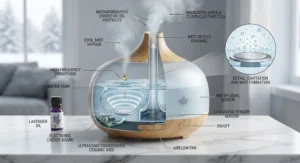
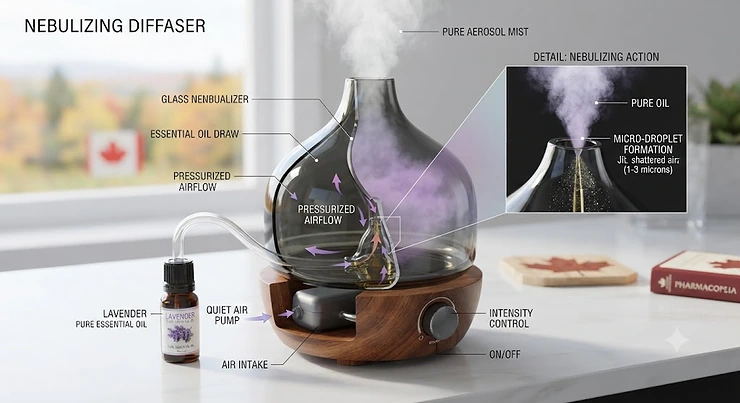
Here’s the short version, which we’ll unpack in painful, useful detail below: an ultrasonic diffuser vibrates a mix of water and essential oil into a fine, visible mist, while a nebulizing diffuser uses pressurized air to atomize pure, undiluted oil with no water involved at all. That one mechanical difference cascades into everything else that matters — how strong the scent throw is, how fast you burn through a bottle of oil, whether the unit adds humidity to your room, and how much you’ll spend replacing parts two winters from now.
This guide walks through seven real, currently available diffusers sold on amazon.ca — three ultrasonic budget-to-mid picks, a Canadian-made ceramic option, and three nebulizing diffusers that show what waterless diffusion actually costs and delivers. Along the way we’ll cover the diffuser mechanism comparison in plain language, work through a genuine diffuser buying guide, and get specific about oil dilution, humidity output, and the maintenance routines each type actually demands. By the end, you’ll know which mechanism belongs in your living room, your office, or your nightstand — not just which one has the prettier product photos.
Quick Comparison: Nebulizing Diffuser vs Ultrasonic Diffuser at a Glance
Before the full breakdown of all seven picks, here’s the nebulizing diffuser vs ultrasonic diffuser divide reduced to five factors that actually decide which one belongs in your home.
| Factor | Nebulizing Diffusers | Ultrasonic Diffusers |
|---|---|---|
| Mechanism | Pressurized air atomizes pure oil | Ultrasonic disc vibrates a water-oil mix |
| Water required | None — fully waterless | Yes, refilled every use |
| Scent strength | Strong, undiluted, fast to fill a room | Milder, gentler on sensitive noses |
| Oil consumption | Faster — full-strength oil, no stretching | Slower — water dilutes and extends each bottle |
| Typical price range (CAD) | C$120-C$420 | Under C$30-C$165 |
The pattern that jumps out immediately is the price inversion: every ultrasonic diffuser in this lineup costs less than every nebulizing diffuser, and that gap isn’t marketing markup — it’s the cost of the pump mechanism and the fact that nebulizing units burn through oil at full concentration instead of stretching it with water. Ultrasonic diffusers double as light humidifiers, which matters in a dry Canadian winter but is a genuine drawback if you live somewhere already humid or you’re diffusing near electronics. Nebulizing diffusers skip that trade-off entirely by never introducing water in the first place, which is also why they tend to deliver noticeably stronger, truer scent — nothing dilutes the oil on its way out.
💬 Just one click — help others make better buying decisions too!😊
Top 7 Nebulizing and Ultrasonic Diffusers: Expert Analysis
We shortlisted seven real, currently listed diffusers on amazon.ca spanning both mechanisms and every price tier — from a sub-C$30 ultrasonic starter unit to a Bluetooth-controlled nebulizing system built for offices and hotels. Budget entries lean ultrasonic; the nebulizing picks climb higher because of the hardware inside them, and that pattern alone tells you most of what you need to know about this category before you’ve read a single spec sheet.
1. InnoGear Essential Oil Diffuser — most forgiving entry point into ultrasonic diffusion
The standout here is simplicity: this is the diffuser most first-time buyers land on by accident, and it’s a genuinely reasonable place to start.
It runs a 150 mL water tank through a standard ultrasonic disc, offers two mist modes (continuous and intermittent), and cycles through seven LED colour options if you want a nightlight along with your scent. On paper, the auto shut-off when the tank runs dry is the feature that matters most — it’s the difference between a diffuser you can leave running unattended and one you can’t. Based on the spec sheet, expect somewhere around 6-8 hours of intermittent runtime per fill, which comfortably covers a workday or an evening of wind-down.
This is squarely a starter-tier ultrasonic diffuser aimed at anyone who wants to try aromatherapy without committing real money to the experiment, and reviewers consistently note that it’s an easy, low-stakes way to test whether diffusing fits into a daily routine at all. A common theme in aggregated feedback is that the mist output feels modest in larger rooms — which tracks, since a 150 mL tank was never built to scent anything bigger than a bedroom or a small office.
Pros:
- ✅ Genuinely low price for a full-featured ultrasonic unit
- ✅ Auto shut-off protects against running the tank dry
- ✅ Compact footprint fits a nightstand or small desk
Cons:
- ❌ Mist output struggles in rooms over roughly 250 square feet
- ❌ Plastic housing feels noticeably less premium than pricier picks
At under C$30 at the time of research, the InnoGear Essential Oil Diffuser is the lowest-risk way to find out which mechanism you actually prefer before spending more.

2. ASAKUKI 500ml Premium Essential Oil Diffuser — best value for filling a genuinely large room
The standout feature is tank size: at 500 mL, this holds more than triple the water of the entry-level pick above, which translates directly into longer unattended runtime.
The spec sheet lists three timer settings (1, 3, and 6 hours) plus a continuous mode, a remote control for adjusting mist intensity from across the room, and seven LED colour options with a dedicated “off” setting for anyone who wants scent without the glow. What most buyers overlook about a tank this size is that it isn’t just about runtime — a bigger reservoir also means a gentler, steadier mist rather than the short, aggressive bursts smaller units rely on to cover the same square footage.
Aggregated review sentiment on this model is unusually consistent for a budget-tier diffuser: buyers frequently cite the remote control as a genuine convenience rather than a gimmick, since it lets you kill the mist from the couch instead of walking back to the unit. A recurring complaint centres on the plastic water tank showing mineral scale after a few months of hard tap water use, which is a maintenance issue rather than a design flaw, and one that regular cleaning largely prevents.
Pros:
- ✅ 500 mL tank covers open-concept living rooms with ease
- ✅ Remote control genuinely improves day-to-day usability
- ✅ Three timer options plus continuous mode add real flexibility
Cons:
- ❌ Hard water can leave visible mineral buildup over time
- ❌ Larger footprint than most budget ultrasonic competitors
Priced around C$30-C$40 at the time of research, the ASAKUKI 500ml Premium Essential Oil Diffuser is the pick for anyone whose room, not their budget, is the limiting factor.
3. HoMedics Ellia Cordless Ultrasonic Aroma Diffuser (Wander) — the only cordless, rechargeable pick in this lineup
The standout advantage is right in the name: this is the one diffuser here you can actually carry from room to room, or toss in a bag, without hunting for an outlet.
Built around a rechargeable internal battery rather than a permanent power cord, the Wander trades tank size for portability — expect a smaller reservoir and a shorter per-charge runtime than the plug-in models above, generally in the range of a couple of hours on a full charge depending on mist setting. Here’s what to weigh: that trade-off makes total sense for a cottage, a hotel room, or a home office you move between, but it’s the wrong choice if your goal is scenting one fixed room for eight hours straight.
The aggregated feedback pattern on cordless diffusers in general, and this one specifically, tends to split along exactly that line — buyers who wanted portability are satisfied, while buyers who expected all-day runtime from a battery-powered unit are the ones leaving disappointed reviews. That’s less a flaw in the product than a mismatch in expectations, which is precisely the kind of thing a spec sheet alone won’t warn you about.
Pros:
- ✅ Genuinely portable — no outlet required to run it
- ✅ Compact ceramic-style housing looks at home anywhere
- ✅ Rechargeable battery avoids constant cord clutter
Cons:
- ❌ Runtime per charge trails every plug-in model here
- ❌ Smaller tank means more frequent refills for regular use
At roughly C$55-C$70 at the time of research, the HoMedics Ellia Cordless Ultrasonic Aroma Diffuser earns its place for anyone whose diffuser needs to travel with them, not stay put.
4. Saje Aroma Om Essential Oil Diffuser — Canadian-made ceramic pick with an unusually wide scent throw
The standout here is provenance and output: this is a Vancouver-designed diffuser from a well-known Canadian wellness brand, and reviewers consistently point to its mist throw as noticeably stronger than other ultrasonic units at a similar price.
The ceramic housing runs a roughly 100-130 mL tank through both continuous and intermittent settings, with a soft LED glow that’s dimmer and less colour-cycling than the budget plastic units above it — a deliberate design choice that reads as more “home décor” than “gadget.” Based on the spec comparison, the ceramic shell likely contributes to the stronger perceived throw, since solid housings tend to direct and concentrate mist more effectively than thin, vented plastic.
What most buyers overlook about a Canadian-made premium ultrasonic diffuser like this one is that the price premium buys you design and material quality, not a fundamentally different diffusion mechanism — it’s still ultrasonic, still water-based, and still subject to the same mineral buildup and runtime limits as every other unit on this list. Aggregated sentiment is largely positive on build quality and scent strength, with occasional notes about the runtime on continuous mode being shorter than expected for the price tier.
Pros:
- ✅ Noticeably stronger scent throw than comparable ultrasonic units
- ✅ Ceramic housing looks and feels genuinely premium
- ✅ Canadian-designed brand with accessible customer support
Cons:
- ❌ Continuous-mode runtime is shorter than the tank size suggests
- ❌ Premium pricing for what is still ultrasonic technology
Typically priced around C$75-C$95 at the time of research, the Saje Aroma Om Essential Oil Diffuser suits buyers who want design credibility alongside their ultrasonic mist.
5. Organic Aromas Raindrop 2.0 — the accessible entry point into true nebulizing strength
The standout feature is right in the mechanism: this is a genuine waterless nebulizing diffuser, built from hand-blown glass on a wood base, and it’s priced to be the gateway into that category rather than its ceiling.
There’s no water tank here at all — a glass reservoir holds your essential oil bottle directly, a small air pump atomizes it, and an auto-off timer cycles the unit on and off (commonly a short on-interval followed by a longer rest) to conserve oil and extend bottle life. Here’s what the spec sheet won’t tell you, but reviewers note repeatedly: the scent output from a genuine nebulizer is dramatically stronger than anything an ultrasonic unit produces, strong enough that most people run it for a fraction of the time they’d run a water-based diffuser to get the same room coverage.
That strength is also the honest trade-off. Because the oil comes out undiluted, a 15 mL bottle empties faster than it would in an ultrasonic unit sipping the same oil mixed with water — a real ongoing cost worth factoring in before you buy. Aggregated review sentiment consistently flags the auto-off timer as essential rather than optional, since running a nebulizer continuously both wastes oil and, in a minority of reports, is linked to motor strain over time.
Pros:
- ✅ True waterless nebulizing delivers noticeably stronger scent
- ✅ Hand-blown glass and wood base look genuinely elegant
- ✅ Works with virtually any essential oil bottle size
Cons:
- ❌ Burns through oil faster than any water-based diffuser
- ❌ No LED lighting or smart features at this price tier
At around C$120-C$155 at the time of research, the Organic Aromas Raindrop 2.0 is the honest starting point for anyone ready to trade convenience for genuine nebulizing power.

6. Vitruvi Stone Diffuser — minimalist ceramic design that hides the tech completely
The standout feature is restraint: no LED lights, no remote, no app — just a matte ceramic vessel that looks like a piece of pottery until you notice the faint mist rising from the top.
Underneath that design-forward shell sits a fairly conventional ultrasonic mechanism with a roughly 90 mL capacity, offering continuous and intermittent settings that top out around 4 to 8 hours per fill depending on mode. On paper, this trades tank size and runtime for something ultrasonic diffusers rarely offer: a housing that genuinely disappears into interior design rather than announcing itself as a gadget on the shelf. Reviewers consistently cite the aesthetic as the primary reason for choosing it over larger, more feature-heavy competitors.
What most buyers overlook is that stripping out lights and electronics doesn’t make this a nebulizing-strength diffuser — it’s still water-diluted ultrasonic mist, just delivered through nicer materials. Aggregated feedback is strongly positive on build quality and quiet operation, with the most common critique being that the smaller tank means more frequent refills than buyers coming from a 300-500 mL plastic unit are used to.
Pros:
- ✅ Design-forward ceramic housing suits any room aesthetic
- ✅ Genuinely quiet operation with no light or gadget clutter
- ✅ Simple two-mode controls with no app required
Cons:
- ❌ Smaller 90 mL tank means more frequent refills
- ❌ No timer beyond the two built-in mist modes
Typically priced around C$135-C$165 at the time of research, the Vitruvi Stone Diffuser is the pick for buyers who want their diffuser to read as furniture, not electronics.
7. AromaTech AroMini BT Plus — smartphone-controlled nebulizing for whole-room, all-day scenting
The standout feature is control: this is a cold-air nebulizing diffuser built around Bluetooth app scheduling, letting you set intensity and timing from your phone rather than a physical dial.
Like the Raindrop above, there’s no water involved — pressurized air atomizes pure oil from AromaTech’s own cartridge-style bottles, and the app lets you dial in exactly how strong and how frequent the bursts are, which matters enormously in a commercial or semi-commercial setting like an office reception area or a small studio. Based on the spec comparison, this unit is engineered for a fundamentally different use case than the six diffusers above it — it’s built for near-continuous operation over weeks, not an evening on a nightstand.
That capability comes at a real price gap, and it’s worth being honest about why: commercial-grade cold-air nebulizing hardware and proprietary Bluetooth control cost more to engineer than a plastic ultrasonic shell, and this unit’s price reflects that rather than marketing markup. Reviewers consistently frame it as a professional-tier purchase — the right call for a private office, a boutique retail space, or a spa reception rather than a typical living room.
Pros:
- ✅ Bluetooth app scheduling adjusts intensity to any room size
- ✅ True waterless nebulizing preserves full, undiluted fragrance
- ✅ Built for continuous, long-term commercial-style operation
Cons:
- ❌ Price puts it well outside typical home-diffuser budgets
- ❌ Requires AromaTech’s own oil cartridges for best results
At roughly C$380-C$420 at the time of research, the AromaTech AroMini BT Plus is the premium end of this entire nebulizing diffuser vs ultrasonic diffuser spectrum — a genuinely different tier of product from everything else on this list.
Nebulizing Diffuser vs Ultrasonic Diffuser: How Each One Actually Works
A nebulizing diffuser is a waterless device that uses pressurized air to atomize pure essential oil into a fine aromatic mist, while an ultrasonic diffuser uses a vibrating ceramic disc to break a water-and-oil mixture into visible micro-droplets. That’s the entire diffuser mechanism comparison in one sentence — everything else in this guide is really just working out the downstream consequences of that single design choice.
Aromatherapy as a practice predates both technologies by centuries, but the delivery hardware has only recently split into these two dominant camps. Ultrasonic diffusion borrows the same basic disc-vibration principle used in cool-mist humidifiers — which is exactly why so many ultrasonic diffusers double as mild humidifiers whether you want that side effect or not. Nebulizing diffusers, by contrast, borrow more from medical nebulizer technology and perfume-atomizer engineering: compressed air forced through a narrow glass or metal jet shears the oil into a fine mist with nothing added to dilute it.
Health Canada’s Natural Health Products Ingredients Database entry on aromatherapy treats essential oils as active substances with real physiological effects, not just pleasant smells — which is a useful reminder that the mechanism delivering them isn’t a purely cosmetic choice. A stronger, undiluted nebulizing mist reaches your nose in a meaningfully more concentrated form than the same oil stretched across a water tank, and that difference in delivery is precisely why nebulizing diffusers are the go-to choice in professional aromatherapy and clinical settings, while ultrasonic units dominate the casual home market.
Nebulizing Diffuser vs Ultrasonic Diffuser: Full Spec Comparison at a Glance
With all seven individual write-ups behind us, here’s the complete nebulizing diffuser vs ultrasonic diffuser lineup side by side — mechanism, capacity, and who each one actually suits.
| # | Diffuser | Mechanism | Capacity | Price Range (CAD) | Best For |
|---|---|---|---|---|---|
| 1 | InnoGear Essential Oil Diffuser | Ultrasonic | 150 mL | Under C$30 | First-time buyers, small rooms |
| 2 | ASAKUKI 500ml Premium Essential Oil Diffuser | Ultrasonic | 500 mL | C$30-C$40 | Large or open-concept rooms |
| 3 | HoMedics Ellia Cordless Ultrasonic Aroma Diffuser | Ultrasonic | Small (battery) | C$55-C$70 | Portable, cordless use |
| 4 | Saje Aroma Om Essential Oil Diffuser | Ultrasonic | ~100-130 mL | C$75-C$95 | Strong ultrasonic throw, design |
| 5 | Organic Aromas Raindrop 2.0 | Nebulizing | Waterless | C$120-C$155 | Entry into true nebulizing power |
| 6 | Vitruvi Stone Diffuser | Ultrasonic | 90 mL | C$135-C$165 | Minimalist design-first buyers |
| 7 | AromaTech AroMini BT Plus | Nebulizing | Waterless (cartridge) | C$380-C$420 | Commercial, whole-room scenting |
Laid out this way, the mechanism-price relationship becomes impossible to miss: every nebulizing diffuser in this table costs more than every ultrasonic diffuser except the very top ultrasonic pick, and the two nebulizing units bookend opposite ends of that category’s own price range. If your budget caps out around C$100, your real choice is between the four ultrasonic picks; if scent strength is non-negotiable and budget is flexible, the Organic Aromas Raindrop 2.0 and AromaTech AroMini BT Plus show what that extra spend actually buys.
✨ Don’t Miss These Exclusive Deals! ✨
🌿 Take your space’s atmosphere to the next level with any of these seven picks — click through to check current pricing and availability on amazon.ca before comparing your options gets harder than it needs to be.
How to Choose Between a Nebulizing and Ultrasonic Diffuser
Working through a genuine diffuser buying guide means starting with your room and your habits, not the feature list on the box. These seven questions, in order, will get you to the right mechanism faster than any spec sheet.
- Start with room size. A nebulizing diffuser’s strong, undiluted mist genuinely fills a large or open-concept space; an ultrasonic diffuser under about 300 mL will feel underpowered in anything bigger than a bedroom.
- Decide how you feel about visible mist and added humidity. Ultrasonic units release a light fog and modest humidity; nebulizing units release scent with no moisture at all, which matters near electronics or in already-humid rooms.
- Budget honestly for ongoing oil use. Nebulizing diffusers use full-strength oil and empty bottles faster; ultrasonic diffusers stretch the same bottle across many more uses thanks to water dilution.
- Weigh noise tolerance. Most ultrasonic discs run near-silent; nebulizing pumps introduce a faint mechanical hum some buyers find more noticeable in a quiet bedroom.
- Check for auto shut-off before anything else. Whichever mechanism you choose, a diffuser without auto-off is a diffuser you can’t safely leave unattended.
- Match maintenance tolerance to your patience. Ultrasonic tanks need regular descaling; nebulizing glass components need occasional deep cleaning to prevent oil residue buildup.
- Read aggregated review themes, not star ratings alone. A 4.3-star diffuser with recurring leak complaints is a worse real-world fit than a 4.1-star unit with none — the pattern matters more than the number.

Water vs Waterless: What Actually Comes Out of the Nozzle
The water vs waterless diffuser question is really a question about what’s mixed into the mist you’re breathing, and it splits cleanly along mechanism lines. An ultrasonic diffuser’s disc vibrates a water-and-oil emulsion into micro-droplets, meaning every breath of that mist is mostly water vapour carrying a small, diluted amount of oil. A nebulizing diffuser skips water entirely, atomizing pure oil directly — nothing dilutes it on the way out.
That distinction drives the humidity output difference between the two mechanisms directly. Because ultrasonic diffusers function as light humidifiers by design, they genuinely raise local humidity in a small room over hours of continuous use — a welcome side effect during a dry Prairie or Ontario winter, and a less welcome one in a coastal or already-humid space where excess moisture can encourage mould near windowsills. Nebulizing diffusers add zero humidity, full stop, which is one reason they’re favoured in humid climates and in settings — like near sensitive electronics or paper archives — where added moisture is a real liability.
There’s a water-quality wrinkle worth knowing too. A peer-reviewed study on humidifier “white dust” found that ultrasonic devices can aerosolize dissolved minerals from tap water directly into the air you breathe, which is why distilled or demineralized water is consistently recommended for ultrasonic diffusers rather than straight tap water. Because oil dilution happens automatically inside an ultrasonic tank, you’re also breathing whatever minerals were in that water alongside your essential oil — a variable that simply doesn’t exist with a nebulizing diffuser, since there’s no water to carry anything extra.
Setting Up and Maintaining Your Diffuser: A Practical Usage Guide
Getting a new diffuser running correctly in the first week sets the tone for how well it performs for the next two years, and the setup steps differ meaningfully by mechanism.
For an ultrasonic diffuser, fill the tank to the marked line using distilled or filtered water — never tap water if you can avoid it — then add 3 to 5 drops of essential oil per 100 mL of capacity as a starting point, adjusting up or down based on room size and personal sensitivity. Run it on intermittent mode for the first few sessions rather than continuous, both to gauge scent strength and to avoid straining a disc that hasn’t been broken in yet. Wipe the tank dry after every use and do a proper vinegar-and-water descaling rinse weekly; skipping this is the single most common reason ultrasonic diffusers stop misting well within a few months.
For a nebulizing diffuser, there’s no tank to fill — you’re connecting an oil bottle directly to the unit’s glass reservoir or adapter. Start with the shortest auto-off interval available and a well-ventilated room, since undiluted mist is genuinely stronger than most people expect on a first run. Most nebulizing manufacturers recommend rinsing the glass nebulizing chamber with rubbing alcohol every few weeks to prevent thicker oils from gumming up the atomizing jet — a maintenance step ultrasonic owners never have to think about, but one nebulizing owners skip at their own peril.
Which Diffuser Type Fits Your Space? Real-World Scenarios
If you’re renting a one-bedroom apartment with a sensitive smoke detector near the kitchen, an ultrasonic diffuser like the InnoGear Essential Oil Diffuser or ASAKUKI 500ml Premium Essential Oil Diffuser is the lower-risk choice — gentle mist, easy cleanup, and no risk of an unfamiliar landlord flagging a strong, unfamiliar scent drifting into a hallway.
If you’re furnishing an open-concept living and dining area where a small diffuser simply disappears into the air volume, the math changes. A single ultrasonic unit under 300 mL will struggle to be noticed at all, which is exactly the scenario where the Organic Aromas Raindrop 2.0‘s undiluted, high-strength mist earns its higher price — you need genuine output, not just a pleasant-smelling corner.
If you’re running a small studio, spa, or professional office where consistent, hands-off scenting matters more than upfront cost, the calculation shifts again. The AromaTech AroMini BT Plus‘s app-scheduled cold-air nebulizing was built precisely for that context — walking in every morning to reset a manual diffuser simply doesn’t scale the way a scheduled app does.
Long-Term Cost & Maintenance: Nebulizing vs Ultrasonic Diffusers
Sticker price only tells part of the nebulizing diffuser vs ultrasonic diffuser cost story — ongoing oil consumption and part replacement over a year or two often matter more than what you paid at checkout.
| Cost Factor | Nebulizing Diffusers | Ultrasonic Diffusers |
|---|---|---|
| Oil consumption rate | Fast — full-strength, undiluted use | Slow — water stretches every bottle |
| Replacement parts | Occasional glass nebulizer cleaning kits | Descaling solution, occasional discs |
| Water costs | None | Distilled water recommended over time |
| Typical annual oil spend | Higher for regular daily use | Lower for equivalent daily use |
Looking at this table, the honest takeaway is that a nebulizing diffuser’s higher upfront price is compounded by faster ongoing oil costs, while an ultrasonic diffuser’s lower purchase price is offset only slightly by descaling supplies and the occasional bottle of distilled water. For someone diffusing daily, an ultrasonic unit like the ASAKUKI 500ml Premium Essential Oil Diffuser will almost always work out cheaper over a full year than a nebulizing unit like the AromaTech AroMini BT Plus, even accounting for the nebulizer’s stronger scent per session. The Government of Canada’s indoor air quality guidance also notes that any appliance introducing moisture into a room, ultrasonic diffusers included, benefits from routine cleaning to prevent mould growth around vents and seals — a maintenance cost worth budgeting time for, even if it doesn’t show up on a receipt.
Common Mistakes When Buying a Nebulizing or Ultrasonic Diffuser
The most common mistake we see in aggregated feedback across this category is buying an ultrasonic diffuser sized for a nightstand and expecting it to scent an entire open floor plan — it’s a mismatch between tank size and room volume, not a defective product. A close second is running tap water through an ultrasonic tank for months on end, then being surprised when mineral scale chokes the disc and mist output drops off a cliff.
On the nebulizing side, the recurring error is skipping the auto-off timer setting entirely, running a unit continuously “to get more scent,” and burning through an expensive bottle of oil in days instead of weeks. A related mistake is choosing a nebulizing diffuser for a small bedroom, where the same undiluted strength that’s perfect for an open living room becomes genuinely overwhelming at close range. Finally, plenty of buyers skip the essential oil dilution question altogether by assuming all oils behave the same in a nebulizer — thicker oils like patchouli or sandalwood can gum up a fine glass jet far faster than lighter citrus oils, which is exactly why most nebulizing manufacturers recommend lighter oils or occasional alcohol rinses to keep the atomizing mechanism clear.

FAQ: Nebulizing Diffuser vs Ultrasonic Diffuser
❓ Is a nebulizing diffuser better than an ultrasonic diffuser?
❓ How long does a bottle of essential oil last in a nebulizing diffuser?
❓ Can you put essential oils directly in an ultrasonic diffuser without water?
❓ Do ultrasonic diffusers raise humidity in a room?
❓ How much essential oil should I use in an ultrasonic diffuser?
Conclusion
The nebulizing diffuser vs ultrasonic diffuser decision really comes down to one honest trade-off: strength and zero water versus affordability and gentler, humidity-adding mist. If you’re scenting a small bedroom or office on a modest budget, a proven ultrasonic pick like the InnoGear Essential Oil Diffuser or ASAKUKI 500ml Premium Essential Oil Diffuser will serve you well for years with minimal fuss. If you need genuine, room-filling strength — or you simply don’t want water and its side effects anywhere near your setup — the Organic Aromas Raindrop 2.0 or the commercial-grade AromaTech AroMini BT Plus deliver a fundamentally different, more concentrated experience that no ultrasonic unit can match.
Whichever mechanism you land on, the buying guide fundamentals stay the same: match capacity to your actual room, respect the maintenance routine your chosen mechanism demands, and never skip the auto-off feature. Get those three right and either type of diffuser — nebulizing or ultrasonic — will earn its spot on your shelf.
✨ Ready to bring better scent into your space? 🌿
Check current pricing on any of the seven diffusers above and find the mechanism that actually fits how you live.
Recommended for You
- Essential Oil Diffuser for Office Desk: 7 Best Picks in 2026
- 7 Best Essential Oil Diffuser for Large Room Picks (2026 Canada)
- 7 Quietest Essential Oil Diffuser for Bedroom Options (2026)
Disclaimer: This article contains affiliate links. As an Amazon Associate, I earn from qualifying purchases. If you purchase products through these links, we may earn a small commission at no additional cost to you.
✨ Found this helpful? Share it with your friends! 💬🤗
