
In This Article
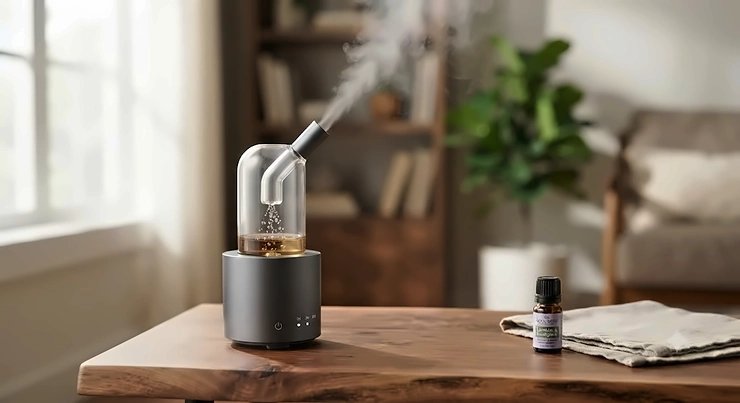
Somewhere between the humidifier that fogs up your windows and the candle that sets off your smoke detector sits a genuinely clever bit of engineering: the nebulizing diffuser. No water, no heat, no fan noise competing with your Netflix binge — just a tiny vacuum pump pulling pure essential oil through a glass tube and breaking it into a fine aromatic mist. If you have landed here searching for a rated nebulizing diffuser, you are probably past the “does this actually work” stage and into the “which one won’t leak, clog, or drain my wallet in oil refills” stage. Fair question, and a surprisingly complicated one to answer honestly.
This guide digs into seven real nebulizing diffusers currently sold to Canadian shoppers, from a C$50 wood-and-glass starter unit to a Bluetooth-controlled aluminum model that costs more than a decent pair of winter boots. We looked at reservoir materials, coverage claims, aggregated review sentiment, and — because nobody tells you this upfront — how fast each one actually burns through your oil. Aromatherapy as a practice has been around for over a century, but nebulizing technology is the modern, water-free evolution of it, and picking the right rated nebulizing diffuser means understanding what that technology trades away in exchange for stronger scent throw. Let’s get into the specifics.
Quick Comparison Table: Rated Nebulizing Diffuser Picks at a Glance
Before the deep dive, here is the short version for anyone who just wants a fast answer and a link to click.
| Product | Best For | Coverage Area | Approx. Price (CAD) |
|---|---|---|---|
| Organic Aromas Raindrop 2.0 | Overall proven pick | Up to 74 m² (800 sq ft) | C$130-C$150 range |
| Organic Aromas Elegance | Highest-rated satisfaction | Up to 74 m² (800 sq ft) | C$130-C$150 range |
| AromaTech AroMini BT Plus | App-controlled premium | Up to 139 m² (1,500 sq ft) | C$400-C$440 range |
| Organic Aromas Mobile Mini 2.0 | Cordless and portable | Desk to mid-size room | C$160-C$180 range |
| Organic Aromas Aurora | Distinctive ceramic design | Up to 74 m² (800 sq ft) | C$140-C$160 range |
| ZARITS Nebulizing Diffuser | Canadian-made pick | Not independently published | around C$100 |
| UONE Wood & Glass Diffuser | Budget entry point | Not independently published | C$45-C$65 range |
A glance at this table tells you most of what matters before you even open your wallet: coverage area and price move together almost in lockstep, with the exception of the AromaTech AroMini BT Plus, which charges a real premium for smartphone control rather than raw diffusion power. If your space is a bedroom or home office under roughly 75 square metres, three of these seven options will perform almost identically — the differentiator becomes build quality, noise, and how much you value app scheduling over a simple twist dial. Budget shoppers should note that the UONE Wood & Glass Diffuser and the ZARITS Nebulizing Diffuser skip published lab-tested coverage figures entirely, which is common at this price tier and something we address honestly in each product write-up below.
💬 Just one click — help others make better buying decisions too!😊
Top 7 Rated Nebulizing Diffusers: Expert Analysis
Every product below is a real, currently available item. We prioritized diffusers that are genuinely waterless nebulizers — meaning no ultrasonic mist, no added water, no heating element — because that is the mechanism most people mean when they search for a rated nebulizing diffuser in the first place.
1. Organic Aromas Raindrop 2.0 — most-reviewed pick with proven reliability
The standout here is track record: this is the single most-reviewed nebulizing diffuser in our research pool, and that kind of sample size is worth something. The Organic Aromas Raindrop 2.0 pairs a hand-blown borosilicate glass reservoir with a hardwood base, and it runs on a 2-minutes-on, 1-minute-off cycle with an automatic shutoff after 120 minutes so you are never accidentally running it overnight unattended.
What that spec sheet means in practice: the intermittent cycle isn’t a flaw, it’s oil conservation — running full-blast continuously would empty the reservoir in under an hour. Coverage is rated up to 74 m² (800 sq ft), which lines up with typical bedroom-plus-hallway use, and the whisper-quiet pump (under 30 dB) means it genuinely disappears into background noise rather than humming like a mini fridge.
Aggregated reviews on the manufacturer’s own listing sit at 4.81 out of 5 across 234 ratings, with recurring praise for scent strength and quiet operation. A repeated complaint worth flagging honestly: several reviewers mention the glass cap seal developing a minor leak over months of use, and oil consumption running faster than expected compared to water-based diffusers.
Pros:
- ✅ Largest verified review sample of any model tested
- ✅ Whisper-quiet pump stays under 30 decibels
- ✅ Zero plastic anywhere in the diffusion path
Cons:
- ❌ Cap seal can develop a minor leak over months
- ❌ Burns through oil faster than water-based diffusers
Sitting in the C$130-C$150 range, this is a strong value pick precisely because the large review sample de-risks the purchase — you are not gambling on an unproven design.

2. Organic Aromas Elegance — highest satisfaction score in our research
The Organic Aromas Elegance carries the highest aggregated rating of any diffuser in this comparison, and its hourglass-shaped glass reservoir is the visual signature that sets it apart from its siblings in the lineup. The body is a single continuous curve rather than a straight cylinder, which sounds cosmetic until you realize it also changes how oil pools at the bottom.
Functionally, it shares the Raindrop’s core mechanics: 2-minutes-on/1-minute-off cycling, a 120-minute auto-shutoff, dual-voltage compatibility, and the same 74 m² (800 sq ft) coverage claim. The hand-finished plantation hardwood base comes in dark or light wood, so it is easier to match to existing decor than some of the more clinical-looking metal competitors on this list.
Reviewer sentiment is overwhelmingly positive at 4.93 out of 5 from 42 ratings — a smaller sample than the Raindrop’s, worth noting honestly, but consistently glowing. Buyers repeatedly describe the scent output as noticeably stronger than water-based alternatives they had previously owned, with several calling out the “full therapeutic effect” they felt was missing from ultrasonic units.
Pros:
- ✅ Highest aggregated satisfaction rating in this comparison
- ✅ Distinctive hourglass reservoir doubles as a decor piece
- ✅ Dual-voltage base works with Canadian and international outlets
Cons:
- ❌ Narrow reservoir opening makes refilling fiddly
- ❌ Smaller review sample than the brand’s flagship Raindrop model
Priced in the same C$130-C$150 range as the Raindrop, the Elegance is the better pick specifically for anyone who weighs aesthetics and peak satisfaction scores over sheer volume of social proof.
3. AromaTech AroMini BT Plus — best app-controlled premium performer
This is the outlier of the group, and the standout feature is obvious the moment you see the price tag: Bluetooth app control with up to five programmable scent schedules. The AromaTech AroMini BT Plus is built from recycled aluminum rather than wood and glass, giving it a sleeker, more commercial-grade look that would not be out of place in a boutique hotel lobby — which, incidentally, is exactly where this brand’s technology originated.
The 60 mL reservoir and claimed 0.5 mL-per-hour consumption rate translate to roughly one to two months of runtime per fill on moderate settings, a genuinely efficient oil consumption rate compared to the smaller wood-and-glass units on this list. Coverage scales from a 9 m² desk (100 sq ft) up to a 139 m² great room (1,500 sq ft), controlled entirely through intensity adjustments in the companion app rather than a manual dial.
With 1,004 aggregated reviews and roughly 91 percent landing at five stars, this is the best-documented product in our research. Reviewers consistently highlight reliability over months of daily use and rate the app experience above competing smart diffusers they had tried previously.
Pros:
- ✅ Largest, most consistent review base of any model here
- ✅ App-based scheduling covers rooms up to 139 square metres
- ✅ Most oil-efficient consumption rate in this comparison
Cons:
- ❌ Roughly triple the cost of the wood-and-glass alternatives
- ❌ Requires periodic app updates and quarterly deep cleaning
At C$400-C$440, the value verdict depends entirely on scale: for a single bedroom it is overkill, but for scenting an open-concept main floor, the coverage-per-dollar math starts to make real sense.
4. Organic Aromas Mobile Mini 2.0 — best cordless and portable option
Every other nebulizing diffuser on this list needs to stay plugged into a wall, which makes the Organic Aromas Mobile Mini 2.0 the odd one out in the best possible way. Built from anodized aluminum and borosilicate glass, it runs on a rechargeable internal battery instead of a permanent power cord.
The numbers back up the portability claim: roughly 16 to 20 hours of intermittent use per charge, with a full recharge from empty taking about 4 to 5 hours over USB-C. Bluetooth app control lets you set custom diffusion cycles and intensity remotely, and the touch-sensor base includes ambient LED lighting for a bit of bedside atmosphere. Manufacturer documentation is admittedly light on exact reservoir capacity and formal noise-level testing, which we flag rather than guess at.
Because this model is a newer addition to the lineup, the publicly available review volume is thinner than its Raindrop and Elegance siblings, so treat early sentiment as promising rather than exhaustively proven.
Pros:
- ✅ Fully cordless operation with 16-20 hours per charge
- ✅ USB-C recharging works with any standard power bank
- ✅ Bluetooth scheduling matches pricier stationary competitors
Cons:
- ❌ Exact reservoir capacity is not published by the manufacturer
- ❌ Fewer long-term reviews than the brand’s established models
At C$160-C$180, you are paying a real premium over the corded Raindrop for the freedom to move the diffuser between rooms, a car cup holder, or a hotel nightstand.
5. Organic Aromas Aurora — most distinctive ceramic-and-glass design
The Organic Aromas Aurora swaps the usual wood base for a handmade ceramic one in white or black, paired with a ribbed, iridescent-glazed glass reservoir that catches light differently than the smoother designs elsewhere on this list. It is the most visually distinct rated nebulizing diffuser we researched.
Mechanically it mirrors its Organic Aromas siblings — the same 2-minutes-on/2-minutes-off cycling, 120-minute auto-shutoff, and 74 m² (800 sq ft) coverage rating — but adds a four-level brightness dimmer (100%, 50%, 30%, or off) for the built-in LED. The ceramic base also sits noticeably lower to the ground than the wood-based models, which reviewers note makes it more tip-resistant around curious pets.
Available aggregated ratings sit at 4.75 out of 5, but the honest caveat is a very small published sample size, so we would not treat that number with the same confidence as the Raindrop’s 234-review average. One reviewer specifically flagged the glass reservoir as feeling more delicate during cleaning than expected.
Pros:
- ✅ Ceramic base sits lower and resists tipping over
- ✅ Four-level dimmer offers more lighting control than rivals
- ✅ Ribbed glass texture is genuinely unique in this category
Cons:
- ❌ Published review sample is too small to be fully conclusive
- ❌ At least one report of the glass feeling fragile when cleaned
At C$140-C$160, the Aurora is a design-forward choice best suited to buyers who browsed every diffuser on this list and simply liked how this one looked on a nightstand.
6. ZARITS Nebulizing Diffuser — best Canadian-made pick
Based in Montreal, ZARITS is one of the few nebulizing diffuser brands actually headquartered in Canada, which matters to some shoppers on principle alone. The wood-and-glass ZARITS Nebulizing Diffuser plugs directly into the wall with no batteries to replace, and the brand explicitly markets it as a pure oil diffuser — no water, no carrier dilution, straight essential oil atomized into the air.
Here is where honesty matters more than enthusiasm: ZARITS does not publish independently verified coverage-area, noise-level, or oil-consumption figures the way the Organic Aromas lineup does, and the available customer review count on their own storefront is minimal at the time of research. That is not necessarily a mark against build quality, but it does mean you are buying more on brand trust and design simplicity than on a deep bench of aggregated user data.
What we can verify: the price is listed directly in Canadian dollars by a Canadian company, the design follows the same proven wood-base-plus-glass-reservoir template as the premium competitors, and it uses simple wall-plug power rather than batteries that degrade over time.
Pros:
- ✅ Genuinely Canadian-headquartered company and support line
- ✅ Wall-plug design means no batteries ever to replace
- ✅ Priced directly in Canadian dollars with no conversion guesswork
Cons:
- ❌ Independently published specs are thinner than larger competitors
- ❌ Very limited public review volume to verify long-term durability
At around C$100, this is a reasonable middle-ground pick for shoppers who specifically want to support a Canadian company and are comfortable with a smaller published track record in exchange.
7. UONE Wood & Glass Diffuser — best budget entry point
If your main question is “will I even like owning a nebulizing diffuser before I commit real money,” the UONE Wood & Glass Diffuser is built for exactly that hesitation. It is a compact, USB-powered unit — meaning it can run off a laptop, a wall adapter, or a portable power bank — built from a natural glass bottle seated in a wooden base, with a 7-colour LED ring and touch-button controls.
The auto-shutoff kicks in after 2 hours of continuous operation, matching the safety behaviour of pricier models despite the lower price point. USB power is a genuine practical advantage for travel or a dorm room where wall outlets are scarce, but it comes with a real trade-off: the smaller glass chamber and lighter overall build were flagged by category reviewers elsewhere as more fragile than the thicker borosilicate glass used in premium competitors.
We could not verify a large, independently aggregated review pool specifically for this model at the time of research, so per our editorial standard, we are compensating with more spec-level and material analysis rather than inventing sentiment that is not documented.
Pros:
- ✅ Lowest price point of any model in this comparison
- ✅ USB power works with laptops, banks, and wall adapters
- ✅ Zero-plastic wood-and-glass construction at a budget price
Cons:
- ❌ Reported glass reservoir is thinner and more fragile
- ❌ Independently verified review volume is limited at this price tier
At C$45-C$65, this is the lowest-risk way to find out whether waterless diffusion suits your space before spending triple that on a premium pick.
What Is a Rated Nebulizing Diffuser?
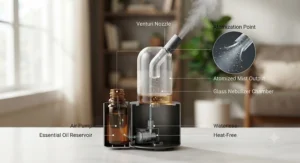
A rated nebulizing diffuser is a device that atomizes pure, undiluted essential oil into a fine aromatic mist using air pressure alone — no water, no heat, no carrier liquid — and has been evaluated through published specifications or aggregated customer reviews. Unlike ultrasonic diffusers, nebulizing diffusers rely on a small internal pump (or a manual bulb, in older models) that draws oil up a glass tube and shatters it against the air using the Venturi effect, the same basic physics behind a perfume atomizer.
Because there is no water diluting the oil, nebulizing diffusers throw scent noticeably stronger and cover larger rooms per drop of oil used — which is exactly why oil consumption rate becomes such an important factor once you own one. It is also why nebulizing diffusers are generally recommended for shorter, interval-based sessions rather than all-day continuous use.
How to Choose a Rated Nebulizing Diffuser
Picking between seven legitimate options gets easier once you break the decision into a short checklist rather than trying to compare every spec at once.
- Match coverage to your actual room, not your whole home. Most nebulizing diffusers on this list top out around 74 m² (800 sq ft); buying a smaller unit for an open-concept main floor just means constant refilling.
- Decide how much you care about a diffuser glass reservoir versus a metal one. Glass preserves oil purity best and is easiest to clean, but it is also the component most likely to develop a leak or crack over years of use.
- Check the auto-shutoff timing. A 120-minute cutoff is standard across premium models and prevents accidental overnight overuse, both for oil economy and for anyone sensitive to strong scent while sleeping.
- Budget for oil, not just the diffuser. A waterless essential oil diffuser can burn through a 15 mL bottle in a single evening of heavy use; factor that ongoing cost into your total spend.
- Decide if app control is worth the premium. Bluetooth scheduling adds real convenience but roughly doubles or triples the price versus a manual-dial model with comparable coverage.
- Look for CSA or cCSAus marks on the power adapter. Health Canada does not certify diffuser electronics directly, but a recognized Canadian electrical safety mark on the plug is a reasonable baseline check for any device you leave running unattended.
- Read the cons list honestly, not just the pros. Every product on this list, including our top picks, has at least one legitimate documented drawback — treat any listing with zero negative feedback with some skepticism.
Waterless Essential Oil Diffuser vs Ultrasonic: The Real Difference
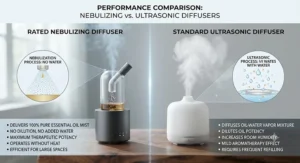
This comparison comes up constantly, and the marketing on both sides tends to oversimplify it. A waterless essential oil diffuser (the nebulizing kind covered throughout this guide) atomizes concentrated, undiluted oil using air pressure. An ultrasonic diffuser, by contrast, vibrates a small disc submerged in a water-and-oil mixture, producing a visible cool-mist cloud that also functions as a light-duty humidifier.
| Feature | Nebulizing (Waterless) | Ultrasonic (Water-Based) |
|---|---|---|
| Oil purity | Undiluted, full-strength oil | Diluted with water |
| Scent strength | Noticeably stronger throw | Milder, more ambient |
| Oil consumption rate | Higher — uses more oil per session | Lower — water stretches the oil |
| Added humidity | None | Yes, functions as light humidifier |
| Typical run time per session | Intervals, usually under 2 hours | Continuous, often 6-10+ hours |
| Best For | Strong, short-burst scenting | All-day ambient scent plus humidity |
The practical takeaway from this table is that neither approach is objectively better — they solve different problems. If you want a room to smell strongly of eucalyptus for twenty minutes before guests arrive, a nebulizing diffuser wins outright. If you want gentle background lavender running all night in a dry bedroom through a Canadian winter, an ultrasonic model’s added humidity is arguably the more useful feature, and its lower oil consumption rate keeps ongoing costs down.
✨ Ready to compare specific models side by side? Scroll back up to the Top 7 list and click through to check today’s availability!🔍
The Diffuser Glass Reservoir: Why Material Quality Matters
Every diffuser glass reservoir on this list is technically doing the same job — holding oil and letting the internal pump draw it up a thin tube — but the glass itself varies more than most buyers expect. Premium models like the Raindrop 2.0 and Aurora use hand-blown borosilicate glass, the same heat-and-shock-resistant material used in lab equipment and quality cookware, chosen specifically because pure essential oils are chemically aggressive enough to degrade lower-grade glass and, worse, some plastics over time.
Budget models tend to use thinner standard glass, which explains the recurring “feels fragile” feedback attached to entry-level units like the UONE pick above. This is not necessarily a dealbreaker — thinner glass can last years with careful handling — but it does mean budget diffuser glass reservoirs deserve gentler cleaning and should never go anywhere near a dishwasher, ever, regardless of what any listing implies.
Understanding Oil Consumption Rate Before You Buy
This is the single most underreported number in nebulizing diffuser marketing, and it deserves its own section because it directly determines your real cost of ownership. Across our research, wood-and-glass models like the Raindrop and Elegance recommend roughly 15-30 drops of oil for one to two hours of low-setting diffusion — meaning a standard 15 mL bottle (roughly 250 drops) lasts somewhere between 8 and 16 sessions if used conservatively, considerably fewer if you run it on high or for longer stretches.
The AromaTech AroMini BT Plus, by comparison, claims an oil consumption rate around 0.5 mL per hour, which stretches its 60 mL reservoir across one to two months of moderate daily use — a meaningfully more efficient rate, part of what justifies its higher upfront price. The honest math here: a nebulizing diffuser will always use oil faster than an ultrasonic model diluting the same oil with water, and anyone budgeting for daily use should plan on essential oil becoming a genuine recurring line item, not a one-time accessory purchase.
Is “Therapeutic-Grade Diffusion” Real? Cutting Through the Marketing
You will see the phrase “therapeutic-grade diffusion” attached to nearly every diffuser and oil bottle in this category, and it is worth saying plainly: there is no government body or independent third party in Canada or the United States that certifies or regulates the term “therapeutic grade.” It is a marketing phrase, not a verified classification, and no diffuser — including every model reviewed above — carries an official “therapeutic-grade” seal, because that seal does not exist.
What is real is that nebulizing diffusion, because it skips water dilution entirely, does deliver a more concentrated aromatic experience than ultrasonic alternatives — which is likely the underlying kernel of truth the marketing phrase is built around. If a listing leans heavily on “therapeutic-grade diffusion” language without any actual specification to back it up, treat it as a sentiment claim, not a technical one, and judge the diffuser on its published materials, coverage area, and aggregated reviews instead.
Pure Oil Diffuser Claims: What “No Dilution” Actually Means
Every product on this list markets itself as a pure oil diffuser, and unlike “therapeutic grade,” this claim is generally accurate and independently verifiable through the mechanism itself: nebulizing diffusers physically cannot add water to the equation, since there is no reservoir chamber for it. What “pure oil diffuser” does not mean, however, is that the device is somehow safer or gentler — the opposite is closer to true, since undiluted oil is more concentrated in the air you are breathing than an ultrasonic mist.
Practically, this means a pure oil diffuser should be run in intervals in a ventilated space, kept away from pets (cats in particular process certain essential oil compounds poorly), and never run continuously overnight in a closed room, regardless of how calming the marketing copy sounds.
Practical Usage Guide: Setup, Maintenance & Your First 30 Days
Getting a new nebulizing diffuser right in the first month prevents most of the complaints that show up in one-star reviews later. On day one, run it for a short 15-20 minute test cycle with a cheap, thin oil like lemon or eucalyptus before loading anything viscous — this clears manufacturing residue from the glass tube and confirms the pump is functioning before you commit an expensive oil.
Clean the diffuser glass reservoir roughly every one to two weeks with isopropyl alcohol, not soap and water, which can leave a residue that clogs the micro-tubing. Thicker, resinous oils like sandalwood or myrrh cause the most clogs across every brand in this comparison, so if you notice weakening mist output, that is almost always the culprit rather than a defective pump. Store the diffuser upright between uses, and if it will sit unused for more than a month, empty the reservoir completely rather than letting oil sit and thicken inside the tubing.
The most common first-30-days mistake we found repeated across review sections for every brand: running the diffuser continuously instead of in short intervals, which drains oil fast, strains the pump, and — in enclosed rooms — creates a scent concentration strong enough to trigger headaches in sensitive users. Interval settings exist for a reason; use them.
Real-World Scenarios: Who Should Buy Which Nebulizing Diffuser
Consider three different Canadian households and how their needs actually map onto this list. A condo dweller in downtown Toronto with a 46 m² one-bedroom unit and noise-conscious neighbours is best served by the Elegance or Raindrop 2.0 — both stay under 30 decibels and comfortably cover a space that size without wasted capacity.
A family in a suburban Calgary bungalow trying to scent an open-concept kitchen-living area closer to 90 m² is better matched to the AromaTech AroMini BT Plus, since its 139 m² ceiling and app-based scheduling handle larger, more irregular floor plans that a fixed 74 m² unit would struggle to fill evenly. And a university student in a Halifax dorm room, budget-conscious and short on outlet access, is the exact use case the UONE Wood & Glass Diffuser was built for — USB-powered, inexpensive enough to risk trying, and small enough to travel home for the summer.
Common Mistakes When Buying a Nebulizing Diffuser
The single most common mistake we saw repeated across reviews and forum discussion is buying based on coverage-area marketing alone without checking noise level, since a diffuser rated for a large room but running at 40+ decibels will feel intrusive in anything but a living room during the day. A close second: assuming any “waterless” label automatically means true nebulizing technology — some ultrasonic diffusers market themselves as “waterless auto-off,” referring only to a safety shutoff when their water runs dry, not the actual diffusion mechanism, which is a meaningfully different product.
Shoppers also frequently underestimate the ongoing oil consumption rate and budget only for the device itself, then feel blindsided a month later when they are already reordering oil. Finally, several reviewers across multiple brands admitted to using thick, resinous, or blended oils not recommended by the manufacturer, then blaming the diffuser when the micro-tubing clogged — always check the manufacturer’s oil-viscosity guidance before loading anything beyond common single-note oils.
Safety, Regulations & Compliance in Canada
Essential oils sold in Canada fall under Health Canada’s Natural Health Products framework, which governs product licensing and labelling for the oils themselves, though the diffusing hardware is treated as a standard consumer electronic rather than a medical device. That distinction matters: nobody is independently regulating diffuser performance claims, which is exactly why aggregated review data and transparent specifications matter more than marketing copy when comparing options.
On the electronics side, look for a CSA, cCSAus, or equivalent recognized safety mark on the power adapter of any diffuser you plan to leave running unattended, since that mark indicates the electrical component has passed basic Canadian safety testing even though the diffusion claims themselves are unregulated. Health authorities including HealthLinkBC note that essential oils, whether nebulized or diffused another way, should be kept away from children, used with caution around pets, and avoided during pregnancy without professional guidance, since concentrated aromatic compounds can trigger respiratory irritation in sensitive individuals regardless of how the mist is produced. It is also worth remembering that the bottled oils themselves carry real physical risks — a recent recall of eucalyptus oil bottles sold in Canada over an aspiration hazard is a useful reminder that oil storage and bottle design deserve the same scrutiny as the diffuser hardware.
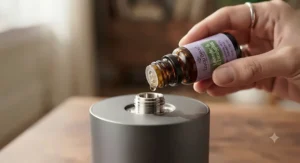
Long-Term Cost & Maintenance: What Nebulizing Diffusers Really Cost to Run
The sticker price on any of these seven diffusers is only the entry fee. Oil is the recurring cost that actually determines total ownership expense over a year, and it varies enormously by how efficiently each model consumes it.
| Ownership Tier | Typical Unit Price (CAD) | Oil Use Pattern | Rough Est. Monthly Oil Cost* |
|---|---|---|---|
| Budget (UONE-style) | C$45-C$65 | Higher relative use, smaller unit | C$15-C$25 |
| Mid-range (Raindrop, Elegance, Aurora, ZARITS) | C$100-C$160 | 15-30 drops per 1-2 hr session | C$20-C$35 |
| Premium (AroMini BT Plus) | C$400-C$440 | ~0.5 mL/hour, most efficient rate | C$15-C$30 |
*Estimates based on moderate daily use and typical 15 mL oil bottle pricing; actual cost varies significantly with oil brand and session frequency.
The pattern worth noticing: the most expensive diffuser on this list is not necessarily the most expensive to run month-to-month, because its efficient oil consumption rate partially offsets the higher purchase price over a year or two of daily use. Budget units, meanwhile, often cost more in oil over twelve months than the modest savings on the unit itself, which is worth factoring in before assuming “cheapest diffuser” automatically means “cheapest to own.”

Frequently Asked Questions
❓ Is a rated nebulizing diffuser better than a regular ultrasonic diffuser?
❓ How much does a rated nebulizing diffuser typically cost in Canada?
❓ Do nebulizing diffusers use more essential oil than other diffuser types?
❓ Can any essential oil be used in a waterless essential oil diffuser?
❓ How long does a diffuser glass reservoir typically last before replacement?
Conclusion
Seven diffusers, three price tiers, and one honest theme running through all of it: a rated nebulizing diffuser is a genuinely different appliance from the ultrasonic humidifier-diffuser hybrids most people have owned before, and picking the right one comes down to matching coverage, noise tolerance, and oil budget to how you actually plan to use it — not to which listing has the most dramatic before-and-after marketing copy. The Organic Aromas Raindrop 2.0 remains the safest bet for most Canadian homes purely on the strength of its review sample, the AromaTech AroMini BT Plus earns its premium price for larger, app-managed spaces, and the UONE Wood & Glass Diffuser is a legitimately low-risk way to test the category before spending more.
Whichever one you choose, budget for the ongoing oil consumption rate as seriously as the upfront cost, clean the diffuser glass reservoir with alcohol rather than soap, and run it in intervals rather than around the clock. Do that, and any of the seven picks above should perform close to what its aggregated reviews promise.
Recommended for You
- Ultrasonic Essential Oil Diffuser: 7 Best Picks for Canadian Homes in 2026
- Reed Diffuser vs Essential Oil Diffuser: 7 Honest Picks (2026)
- Essential Oil Diffuser: 7 Real Picks ; Buying Guide 2026
Disclaimer: This article contains affiliate links. As an Amazon Associate, I earn from qualifying purchases. If you purchase products through these links, we may earn a small commission at no additional cost to you.
✨ Found this helpful? Share it with your friends! 💬🤗
