
In This Article
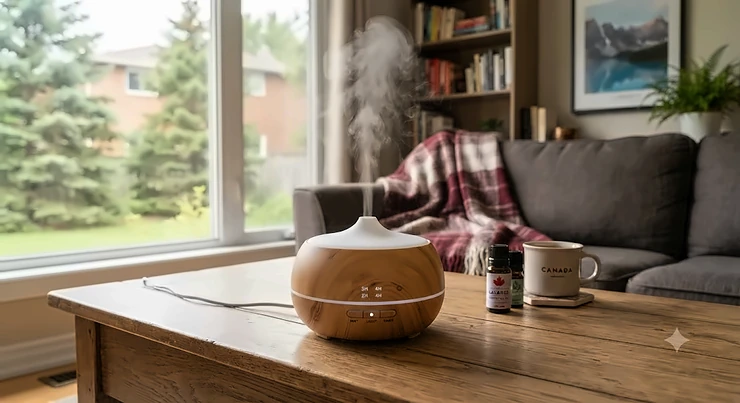
An essential oil diffuser with timer is an ultrasonic or waterless aromatherapy device that lets you preset how long it runs — typically in one, three, or six-hour intervals, or on an intermittent cycle — so it shuts off on its own instead of misting until the tank runs dry. That small feature is the difference between a diffuser you can trust near a sleeping toddler and one you have to babysit like a pot on the stove.

If you have ever wandered into the living room at 11 p.m. and found your diffuser still huffing away three hours after you fell asleep on the couch, you already understand why the timer matters more than the scent. Canadian winters push us indoors for months at a stretch, and a lot of us have started leaning on diffusers the way our grandparents leaned on a kettle on the stove — for warmth, for calm, for something that smells like it isn’t -20°C outside. But an unattended appliance running non-stop in a dry Prairie bungalow or a humid Maritime basement is a different risk profile than the same device in a well-ventilated condo, and Health Canada’s guidance on cool-mist devices flags exactly this kind of unattended, always-on use as worth paying attention to.
This guide breaks down seven real, currently available models sold through Amazon.ca, ranging from simple budget units under C$35 to design-forward premium picks, and it digs into what the timer settings, mist interval modes, and auto shut-off circuitry actually mean for your electricity bill, your sleep, and your peace of mind. We will also cover how programmable diffusers compare with old-school plug-in warmers, when a nursery needs a different unit than a home office, and the buying mistakes that trip up almost everyone the first time around.
Quick Comparison: Essential Oil Diffuser With Timer Models at a Glance
| Product | Capacity | Timer Options | Best For | Price Range (CAD) |
|---|---|---|---|---|
| URPOWER 2nd Generation Diffuser | 300ml | 4 timer settings | Tightest budget | C$25–C$35 |
| InnoGear 300ml Premium 5-in-1 | 300ml | 60/180/360-min + continuous | Best value flexibility | C$30–C$40 |
| VicTsing 500ml Diffuser | 500ml | 1H/3H/6H/continuous | Quiet bedrooms | C$30–C$40 |
| ASAKUKI 500ml with Remote | 500ml | 1H/2H/3H, intermittent/continuous | Larger rooms, remote use | C$40–C$55 |
| Levoit Essential Oil Diffuser | 300ml | 1/3/6-hour/steady | Trusted mainstream pick | C$35–C$45 |
| HoMedics SereneScent Waterless | 120ml oil pad | App-set timer | No mess, cordless | C$150–C$190 |
| Vitruvi Stone Diffuser | 90ml | 3H continuous / 7H interval | Design-conscious living rooms | C$150–C$180 |
Looking at this lineup, the spread in timer sophistication is bigger than most shoppers expect walking in. The budget trio (URPOWER, InnoGear, VicTsing) all offer multiple fixed intervals but rely on physical buttons, while the ASAKUKI adds remote convenience and the HoMedics brings smartphone-app control into the mix entirely. Note too that price does not track neatly with timer quality — the Levoit, a mid-priced mainstream name, actually matches the timer granularity of units costing three times as much.
💬 Just one click — help others make better buying decisions too!😊
Top 7 Essential Oil Diffusers With Timer: Expert Analysis
1. URPOWER 2nd Generation Diffuser — best true budget pick with reliable auto shut-off
The standout here is simple: this is one of the cheapest ways into a genuinely functional timer-equipped diffuser without falling back on a no-name model with zero safety switch. The 300ml ultrasonic tank runs roughly 6 to 7 hours on a full fill in continuous mode, and the adjustable mist mode lets you throttle output down for a small bedroom or a cracked-open office door. Waterless auto shut-off kicks in the moment the reservoir runs dry, which matters more than it sounds — cheap diffusers without this feature can run their ultrasonic disc dry and burn out the mechanism within a single unattended session.
Based on the spec comparison against pricier competitors, what stands out is that URPOWER didn’t cut corners on the one feature that actually protects the unit and your home: the safety cutoff. What it did trim is finish quality and light customization — you get seven fixed colour options rather than a dimmer or app control. This is the pick for a student apartment, a first diffuser purchase, or a backup unit for a room you don’t want to overthink.
Aggregated feedback across major Canadian and U.S. retail listings for this diffuser line consistently notes long-term reliability relative to its price point, alongside a recurring complaint that the plastic housing feels noticeably lighter-duty than the metal-accented competitors further up this list.
Pros:
- ✅ Genuine waterless auto shut-off at this price point
- ✅ Adjustable mist output for small vs. larger rooms
- ✅ Simple one-button operation, no learning curve
Cons:
- ❌ Light plastic housing feels less premium
- ❌ Only fixed LED colours, no dimming or app control
At around C$25–C$35, this is the lowest-friction entry point into timer-equipped diffusing, and for anyone who just wants the feature working reliably without paying for polish, it delivers solid value.
2. InnoGear 300ml Premium 5-in-1 Diffuser — best value for three-interval timer flexibility
What makes this one worth a second look is the genuinely useful three-step interval system: 60, 180, or 360 minutes, plus a continuous option that runs until the 300ml tank empties on its own. In practice, that 60-minute setting is the one most reviewers underuse and shouldn’t — it is exactly right for a short afternoon nap or a quick scent refresh before guests arrive, without committing the unit to hours of runtime you don’t need.
The 10-hour maximum continuous runtime and 23 dB noise rating put this in a comfortable middle tier: quiet enough for a nightstand, but not marketed as a dedicated “sleep” unit the way some premium models are. Here’s what to weigh — InnoGear frames this as a “5-in-1” device (diffuser, humidifier, night light, aromatherapy tool, and room air freshener), and while that is standard marketing language across this category, the underlying hardware genuinely does double as a light-duty humidifier for a small bedroom in a dry Prairie winter.
Reviewers consistently report that the timer buttons are more intuitive than competing budget models, though a recurring theme in user feedback is that the water tank’s narrow opening makes refilling and cleaning slightly fiddlier than diffusers with a wide-mouth reservoir.
Pros:
- ✅ Three distinct timer intervals plus continuous mode
- ✅ Quiet 23 dB operation suits bedrooms and offices
- ✅ Doubles as a light humidifier in dry winter air
Cons:
- ❌ Narrow tank opening complicates refilling and cleaning
- ❌ Single mist-output mode limits fine-tuning
Priced in the C$30–C$40 range, the InnoGear earns its spot as the timer-flexibility pick for buyers who want more granular control than the absolute cheapest models offer.
3. VicTsing 500ml Diffuser (Reduce Noise Design) — quietest mist output in this lineup
The advantage that sells this one is right in its name: VicTsing engineered this specifically to reduce operating noise, and the larger 500ml tank stretches that quiet operation across a genuinely long runtime — up to 14 hours on the low-mist setting, or roughly 20 hours of total working time when you factor in the auto shut-off cycling. The 1H/3H/6H/continuous timer bank covers nearly every use case, from a short living-room refresh to an entire overnight cycle.
What most buyers overlook about this model is the dual mist-intensity system (indicated by one beep for high output, two for low) layered on top of the timer — it means you are not just choosing how long the diffuser runs, but how aggressively it runs during that window, which is the closest thing to true interval customization in the sub-C$50 bracket. The auto shut-off engages within about 5 seconds of the tank running dry, a faster response than several competitors in this price range claim.
Based on the spec sheet and aggregated review themes, this unit shows up often in feedback threads specifically for bedroom use, where the quieter low-mist setting paired with the 6-hour timer is frequently cited as the preferred overnight configuration — though some users note the coloured light ring, while dimmable, cannot be fully disabled on every generation of this model.
Pros:
- ✅ Class-leading quiet operation for bedroom use
- ✅ Four timer settings plus dual mist-intensity control
- ✅ Long 500ml tank runtime reduces overnight refills
Cons:
- ❌ LED ring cannot be fully switched off on some units
- ❌ Coverage tops out around 323 sq ft, not whole-floor
Sitting in the C$30–C$40 range, the VicTsing is the strongest pick here specifically for light sleepers who still want a full night of coverage.
4. ASAKUKI 500ml Premium Diffuser with Remote Control — best remote-control convenience for larger rooms
The feature that separates this model from the rest of the lineup is the wireless remote, usable from roughly 5 metres (16.5 feet) away — genuinely handy when the diffuser sits across an open-concept living room and you don’t want to get up to adjust it. On top of the 1H/2H/3H timer bank, ASAKUKI adds an intermittent mist mode alongside continuous output, so you can stretch a single tank’s diffusing time across a longer stretch without running the ultrasonic disc non-stop.
At 12 watts of power draw and a claimed 23 dB noise floor, the real-world meaning is that this unit sips electricity — running it for six hours costs a fraction of a cent — while staying quiet enough for a shared home office. On paper, the 350-square-foot coverage claim and 500ml tank make this one of the better-suited units here for a larger great room or open kitchen-living space rather than a single bedroom, which is exactly where the remote earns its keep.
User feedback aggregated across retail platforms frequently praises the remote’s range and the intermittent mode’s fuel economy for oil use, while a recurring complaint centres on the plastic build feeling less durable than the price might suggest given the added remote hardware.
Pros:
- ✅ Working remote control up to 5 metres away
- ✅ Intermittent and continuous mist modes on one unit
- ✅ Low 12W power draw keeps running costs minimal
Cons:
- ❌ Build quality feels underwhelming for the price tier
- ❌ Only three timer intervals versus four on some rivals
In the C$40–C$55 range, this is the pick for anyone diffusing across a bigger open floor plan who wants to adjust settings from the couch.
5. Levoit Essential Oil Diffuser (300ml) — most trusted brand-name reliability
Levoit built its reputation on humidifiers and air purifiers before applying that engineering discipline to a compact diffuser, and it shows in the details: a 21 dB noise floor that undercuts nearly every competitor here, and a genuinely useful 1-hour/3-hour/6-hour/steady-on timer bank that mirrors what you would find on the brand’s pricier humidifiers. The 300ml tank covers a claimed 15–30 square metres (161–323 sq ft), putting it comfortably in single-bedroom-to-small-living-room territory.
Here’s what the spec sheet won’t tell you outright, but the brand’s broader product ecosystem suggests: Levoit’s manufacturing scale means components like the ultrasonic transducer and auto shut-off sensor tend to be more consistently calibrated unit-to-unit than smaller aromatherapy-only brands, which matters for the auto-off trigger actually firing reliably every time the tank runs dry rather than most of the time.
Reviewers consistently point to the two-brightness, seven-colour LED system as more refined than rivals’ fixed-colour setups, and the brand’s established customer service channel is mentioned favourably more often than with smaller diffuser-only companies — though the 300ml tank means more frequent refills than the 500ml options on this list if you’re running it on the 6-hour setting nightly.
Pros:
- ✅ Exceptionally quiet 21 dB operation
- ✅ Four-stage timer matching premium humidifier logic
- ✅ Strong brand reliability and customer support
Cons:
- ❌ Smaller 300ml tank needs more frequent refills
- ❌ Coverage area trails the 500ml competitors here
Around C$35–C$45, the Levoit is the safe, dependable choice for buyers who would rather trust an established name than gamble on a newer brand.

6. HoMedics SereneScent Waterless Diffuser — best waterless, mess-free option
This is the odd one out on this list in the best way: there is no water tank at all. The SereneScent uses a rechargeable, cordless design paired with HoMedics’ patented air-diffusion technology to push scent from a fragrance-oil cartridge directly into the room, with an integrated timer and three mist-intensity settings controlled through a companion app. That means no mineral scaling, no mould risk in stagnant water, and no ultrasonic disc to eventually wear out from hard water deposits — a genuinely different maintenance profile than every other diffuser in this roundup.
What most buyers overlook when they see the higher price tag is that they are not paying for a bigger tank or a fancier remote — they are paying to eliminate the entire water-and-cleaning cycle that drives most complaints about ultrasonic diffusers. Based on the spec comparison, the trade-off is that you are locked into HoMedics-branded fragrance oil cartridges rather than any essential oil bottle in your cupboard, so ongoing costs run differently than a traditional ultrasonic unit.
Aggregated retailer feedback highlights the cordless portability — moving it from kitchen counter to bedroom without hunting for an outlet — as the most-cited advantage, while some reviewers note that scent throw is noticeably softer than water-based ultrasonic diffusers, which suits subtle ambient fragrance better than a strong, room-filling aroma.
Pros:
- ✅ Zero water means zero mould or mineral buildup risk
- ✅ Cordless, rechargeable design goes anywhere in the home
- ✅ App-controlled timer and three mist-intensity levels
Cons:
- ❌ Requires proprietary HoMedics fragrance cartridges
- ❌ Noticeably softer scent throw than ultrasonic tank models
Priced around C$150–C$190, this is the premium pick for anyone who has grown tired of descaling a diffuser every few weeks and is willing to pay for convenience over raw scent strength.
7. Vitruvi Stone Diffuser — best designer aesthetic for open-concept living
The Stone earns its reputation on looks first: a matte-ceramic shell that reads more like a piece of pottery than an appliance, which is exactly why it shows up on so many “best diffuser” lists aimed at design-conscious buyers. Underneath that finish sits a genuinely capable 90ml ultrasonic system with two timer modes — a 3-hour continuous setting (signalled by a green light) and a 7-hour interval setting that mists in short 30-second bursts (orange light) to stretch a single fill across most of a workday or a full evening.
On paper, the claimed 538-square-foot diffusing capacity is the largest coverage figure of any product in this lineup, which makes sense of its popularity in open-concept condos and lofts where a single small device needs to scent a combined kitchen-living space rather than one closed room. What the marketing photos won’t tell you is that the auto shut-off is a genuine dual-trigger system — it powers down both when the timer session ends and independently when the reservoir runs dry, so you are not relying on a single point of failure for safety.
Reviewers and design publications alike consistently cite the aesthetic and the 7-hour interval mode’s gentle scent output as the main draws, while a recurring theme in ownership feedback is that the compact 90ml tank needs refilling more often than its square-footage marketing might suggest for buyers actually using it in a large space daily.
Pros:
- ✅ Ceramic design that doubles as home décor
- ✅ Dual-trigger auto shut-off (timer and waterless)
- ✅ Largest claimed coverage area in this roundup
Cons:
- ❌ Small 90ml tank needs frequent refills for its coverage claim
- ❌ Premium price well above functionally similar budget models
At roughly C$150–C$180, the Vitruvi Stone is the pick for buyers who want their diffuser to look intentional on an open shelf, not tucked out of sight in a corner.
Setting Up and Programming Your Diffuser Timer: A Practical Guide
Getting a new diffuser right in the first week comes down to three habits. First, always fill the tank to the marked line, not above it — overfilling is the single most common cause of a timer-equipped diffuser misbehaving, because the ultrasonic disc needs headroom to vibrate water into mist, and an overfull tank can trip the auto shut-off prematurely or leak around the seal. Second, add essential oil to water rather than the reverse, and stick to 3 to 5 drops for a 300ml tank or up to 8 to 10 drops for a 500ml unit; concentrated oil residue is what clogs the ultrasonic disc over time and eventually kills the timer function along with everything else.
Third, actually use the interval settings instead of defaulting to continuous mode every time. If your model offers a 1-hour and a 6-hour option, matching the setting to the activity — 1 hour while cooking to mask kitchen smells, 6 hours or the overnight interval mode while sleeping — extends the life of the unit and avoids the over-saturated, headachy air that comes from non-stop diffusing in a closed bedroom.
A basic maintenance schedule matters just as much as the timer itself: wipe the tank dry after every use, run a vinegar-and-water rinse through the reservoir every one to two weeks depending on how hard your tap water is, and never let water sit in the tank between sessions, which is precisely the guidance Health Canada gives for cool-mist devices generally. Skipping this step is the most common mistake in the first 30 days of ownership, and it is the one most likely to make the timer feel unreliable when the real problem is mineral buildup on the sensor.
Real-World Scenarios: Which Diffuser Timer Fits Your Life
Consider a shift worker in Halifax who sleeps during the day and needs the bedroom dark and quiet from 9 a.m. to 5 p.m. — the VicTsing 500ml’s 6-hour timer paired with its low-mist setting covers almost the entire sleep window on one fill, and the quiet operation matters more to this buyer than remote control or app features ever would. Compare that to a young family in Calgary running a home office and a toddler’s nap schedule out of the same open floor plan; the ASAKUKI’s remote lets a parent adjust the timer from across the room without waking a napping child, and the 350-square-foot coverage handles the shared space without needing two separate units.
Then there’s the condo-dwelling professional in downtown Toronto who wants a diffuser that looks intentional on an open shelf next to books and plants — the Vitruvi Stone’s 7-hour interval mode quietly scents the space through a full workday of video calls, and its ceramic finish means it never looks like it’s hiding. And for the renter who has moved twice in the last two years and refuses to buy anything with a water tank to clean before the next move, the HoMedics SereneScent’s cordless, cartridge-based design travels from apartment to apartment without so much as a power outlet to plan around.
Budget matters as much as lifestyle here: a student on a tight budget in a shared house does not need a 500-square-foot coverage claim for a 3-metre by 4-metre bedroom, and the InnoGear’s 60-minute setting is arguably the more useful feature for that buyer than any premium model’s app control.
Common Diffuser Timer Problems (And How to Fix Them)
The timer won’t shut off on schedule. This is almost always mineral scale on the water-level sensor, not a broken timer chip — a vinegar rinse (roughly one part white vinegar to three parts water, run through a short cycle with no oil) resolves it in the vast majority of cases reported across user forums for the URPOWER, InnoGear, and VicTsing models alike.
The mist output drops off well before the timer ends. This usually points to a partially clogged ultrasonic disc from oil residue rather than the timer itself misbehaving; reduce oil concentration on the next fill and clean the disc gently with a cotton swab dipped in isopropyl alcohol.
The diffuser shuts off almost immediately after starting. On most models, this is the waterless auto shut-off triggering falsely because the tank was underfilled below the minimum line — refill to the marked fill line rather than eyeballing it.
The remote or app stops responding (ASAKUKI or HoMedics). Battery depletion in the remote, or a lost Bluetooth/Wi-Fi pairing after a router reset, accounts for the overwhelming majority of these complaints in aggregated reviews — a fresh battery or a manual re-pair typically fixes it without needing a warranty claim.
The unit smells musty even with the timer working. This signals stagnant water sitting in the tank between uses, precisely the mould-growth risk Health Canada warns about with cool-mist devices — empty and dry the tank after every session rather than leaving water in reserve for the next one.
How to Choose an Essential Oil Diffuser With Timer: 7 Steps
- Match tank size to room size first. A 90–150ml tank suits a single bedroom or home office; a 400–500ml tank is the better fit for open-concept living rooms or shared spaces.
- Count the timer intervals, not just the number on the box. A unit offering 1/3/6-hour settings gives you real flexibility; one offering only “on” and “off” does not, regardless of marketing language.
- Check for a genuine waterless auto shut-off, not just a timer. These are two different safety mechanisms, and the best units — like the Vitruvi Stone — trigger on both independently.
- Weigh noise rating if the diffuser is going in a bedroom. Anything above roughly 30 dB becomes noticeable in a silent room at night; the Levoit and VicTsing both undercut that threshold.
- Decide whether remote or app control is worth the premium. It is genuinely useful for larger rooms or shared spaces, less so for a nightstand unit you can reach without getting up.
- Factor in maintenance tolerance. Waterless models like the HoMedics SereneScent eliminate tank cleaning entirely, at the cost of proprietary fragrance cartridges instead of any essential oil bottle.
- Set a realistic price ceiling before you shop. The functional difference between a C$30 unit and a C$180 unit is real but incremental — the jump buys you quieter operation, app control, or design, not a fundamentally different core function.

Diffuser Interval Settings and Mist Modes Explained
Not all “timer settings” mean the same thing across brands, and this is where a lot of shoppers get confused reading Amazon listings side by side. A fixed timer, like the 1H/3H/6H options on the VicTsing or Levoit, simply cuts power to the unit entirely once the countdown ends — the mist stops, the light (if any) stops, and you need to restart it manually for another session. An interval or intermittent mist mode, like the Vitruvi Stone’s 7-hour setting or the ASAKUKI’s intermittent option, is different: the unit keeps running for the full duration but cycles the ultrasonic disc on and off in short bursts — commonly around 30 seconds on, 30 seconds off — to stretch a single tank of water across a longer window without running the disc continuously.
What most buyers overlook is that intermittent mode is not just a battery-life gimmick on cordless units — on plug-in ultrasonic diffusers it is primarily about extending tank life and moderating how saturated the air gets with scent, since continuous misting in a small closed room can overwhelm the space well before the timer session ends. A programmable diffuser that lets you separately set both the total session length and the mist duty cycle — as the higher-end units in this list do — gives you meaningfully more control than a basic on/off timer, particularly for anyone sensitive to strong scents or sharing a space with someone who is.
Common Mistakes When Buying an Essential Oil Diffuser With Timer
Buying based on tank size alone. A 500ml tank sounds like better value than a 300ml one, but if your bedroom is small, you’ll end up running it on low-mist settings anyway and rarely use the extra capacity — meanwhile the larger tank usually means a bigger footprint on a nightstand.
Assuming “auto shut-off” and “timer” are the same feature. They frequently are marketed together but function independently; a unit can have a timer with no waterless shut-off (running dry and risking the ultrasonic disc), or vice versa. Check both are present.
Ignoring the room-sharing reality of scent. Placing a strong-diffusing unit in an open-plan space without considering that a partner, roommate, or coworker might be fragrance-sensitive is a common oversight — the Canadian Centre for Occupational Health and Safety’s guidance on scent-free workplaces exists precisely because reactions to airborne fragrance are a real, documented issue for a meaningful share of people, not a minor preference.
Overlooking cleaning requirements before buying. Every water-tank diffuser needs regular descaling; buyers who skip this research often end up blaming a “broken timer” a few months in when the real issue is mineral buildup that a two-minute vinegar rinse would have prevented.
Chasing the cheapest possible price without checking for a certified plug and cord. A diffuser is a low-voltage device, but a poorly made power adapter is still an electrical fire risk — check for CSA or equivalent certification markings before purchasing, especially on lesser-known brands.
Essential Oil Diffuser vs Humidifier: What’s the Real Difference
| Factor | Essential Oil Diffuser | Traditional Humidifier |
|---|---|---|
| Primary purpose | Aromatherapy scent dispersal | Raising room humidity |
| Typical tank size | 90–500ml | 2–6 litres |
| Timer sophistication | Often multi-interval (1H/3H/6H) | Usually simple on/off or smart app |
| Oil compatibility | Designed for essential oils | Not designed for oil use |
| Best For | Small-to-medium rooms, mood and scent | Whole-room dry-air relief, larger units |
The overlap between these two categories is real — both use ultrasonic technology to turn water into a fine mist, and several of the products in this guide are explicitly marketed as doing double duty. The meaningful difference is intent and scale: a diffuser’s small tank and oil-safe reservoir are built for scent in a contained space over a few hours, while a dedicated humidifier’s much larger tank is engineered to meaningfully shift the humidity of an entire room over many hours, which a 300ml diffuser tank simply cannot do at any timer setting. If dry winter air, not scent, is your primary problem, a dedicated humidifier with a larger reservoir will outperform any diffuser on this list, timer features aside.
✨ Don’t Miss These Exclusive Deals! 🔍
Take your home aromatherapy setup to the next level with these carefully selected diffusers. Click on any highlighted item to check current pricing and availability. These tools will help you create a calmer, better-scented home your family will love!
Auto Shut-Off and Overnight Use Safety: What Canadian Buyers Should Know
Running any electrical appliance unattended overnight deserves a bit more scrutiny than daytime use, and diffusers are no exception. The genuinely reassuring news is that every product in this roundup includes some form of waterless auto shut-off, meaning the unit stops misting once the tank runs dry rather than running the ultrasonic disc — or, on the HoMedics, the internal fan — against nothing. That said, an auto shut-off is not the same as a recommendation to leave any electrical device running in a closed bedroom all night without a second thought.
Health Canada’s guidance on cool-mist devices, the broader category ultrasonic diffusers belong to technically, specifically recommends keeping this type of unit in a central location rather than directly in the bedroom overnight, and stresses that stagnant water left in a tank between uses is the real risk — not electrical failure, but bacterial or mould growth that gets aerosolized into the room’s air. Practically, that means the safest overnight setup pairs a genuine multi-hour timer (so the unit is not running the full eight hours you’re asleep) with a strict habit of emptying the tank each morning rather than topping it up.
Pets add another layer worth taking seriously. Certain essential oils, including tea tree and some citrus oils, are documented as genuinely harmful to cats in particular, and CBC News has reported on veterinary caution around exactly this kind of household aromatherapy use. The practical takeaway is not to avoid diffusing altogether if you have a cat or dog, but to research oil-specific pet safety before adding anything beyond the mildest, pet-vetted oils to your tank, and to favour rooms pets can leave rather than closed spaces they’re confined to.
Energy Efficiency and Long-Term Cost of Running a Diffuser
Ultrasonic diffusers are genuinely cheap to run, and the numbers back that up better than most people assume. The ASAKUKI, for example, draws roughly 12 watts — running it for a full 6-hour timer cycle every night for a month works out to a fraction of what a single incandescent lightbulb left on the same schedule would cost, since most of these units sip power in the single-digit-to-low-teens wattage range rather than pulling meaningful current the way a space heater or full-size humidifier does.
Here’s what most cost breakdowns miss: the ongoing expense of running a diffuser is overwhelmingly the essential oil itself, not the electricity. A bottle of oil lasting a few weeks of nightly 3-to-5-drop use typically costs more over a year than the electricity to run the diffuser that entire time, several times over. Where energy efficiency does matter more than people expect is standby draw — a diffuser left plugged in but powered off between uses still pulls a trickle of electricity, and Natural Resources Canada’s guidance on standby power notes this “phantom load” adds up across a household’s full set of always-plugged-in devices, even when each individual draw looks negligible on paper.
The practical move for a genuinely energy-conscious household is not to avoid diffusing, but to unplug the unit between uses rather than leaving it on standby around the clock, and to lean on the shorter timer intervals rather than continuous mode by default — both cut cumulative electricity draw without sacrificing the aromatherapy benefit you’re actually paying for.
Essential Oil Diffusers for Different Canadian Spaces
A home office shared with a partner working calls all day needs the quietest possible unit — the Levoit’s 21 dB rating or the VicTsing’s reduced-noise design are the better fits here over anything marketed primarily on remote convenience. An open-concept condo living space, by contrast, benefits more from raw coverage than whisper-quiet operation, which is exactly where the Vitruvi Stone’s 538-square-foot claim and the ASAKUKI’s 350-square-foot range earn their keep.
A nursery is its own category entirely: skip strong essential oil blends altogether in a room where an infant sleeps for extended stretches, favour the shortest available timer setting over anything approaching continuous mode, and prioritize a unit with a soft, dimmable night light rather than bright fixed-colour LEDs that can disrupt sleep cycles. A rental unit or shared house, meanwhile, is where the HoMedics SereneScent’s cordless, no-plumbing-adjacent design genuinely shines, since it moves between rooms — or apartments — without leaving mineral deposits or a permanent outlet commitment behind. And in a workplace common area, the Canadian Centre for Occupational Health and Safety’s scent-free workplace guidance is worth reading before introducing any diffuser at all, given how many workplaces have moved toward fragrance-free policies specifically because of documented sensitivities among staff.
Frequently Asked Questions
❓ What is the best essential oil diffuser with timer for overnight use?
❓ How long can you leave a diffuser on with a timer?
❓ Do all essential oil diffusers have auto shut-off?
❓ Is it safe to run an essential oil diffuser all night?
❓ How much electricity does an essential oil diffuser use?
Conclusion
Choosing the right essential oil diffuser with timer comes down to matching three things honestly: your room size, your tolerance for maintenance, and how much you actually value extras like remote or app control over straightforward reliability. The URPOWER and InnoGear cover the budget end without skimping on the safety features that matter, the VicTsing and Levoit split the difference between quiet, dependable performance and mid-range pricing, the ASAKUKI adds genuine remote convenience for bigger spaces, and the HoMedics SereneScent and Vitruvi Stone represent two very different premium philosophies — one built around eliminating water-tank maintenance entirely, the other built around looking intentional on an open shelf.
None of these seven require you to gamble on an unbranded, no-name unit with a vague safety rating just to get timer functionality on a budget. Whichever you choose, the same underlying habits apply regardless of price: fill to the marked line, don’t overdo the oil, empty the tank rather than let water sit, and use the shortest timer setting that actually fits what you’re doing rather than defaulting to continuous mode out of habit.
🕐 Ready to stop babysitting your diffuser? Check current prices on today’s pick and let the timer do the work tonight!
Recommended for You
- 7 Best Smart Essential Oil Diffusers for Canadian Homes (2026)
- Rated Nebulizing Diffuser: 7 Best Picks for Canadians in 2026
- Ultrasonic Essential Oil Diffuser: 7 Best Picks for Canadian Homes in 2026
Disclaimer: This article contains affiliate links. As an Amazon Associate, I earn from qualifying purchases. If you purchase products through these links, we may earn a small commission at no additional cost to you.
✨ Found this helpful? Share it with your friends! 💬🤗
