
In This Article
Your reed diffuser has gone quiet. The sticks are bone-dry, the bottle’s nearly empty, and that lovely vanilla-and-cedar cloud that used to greet you at the front door has faded into “vaguely plastic.” This is the moment most Canadians either give up on reed diffusers entirely or start Googling reed diffuser oil refills at 11 p.m., phone brightness cranked down so they don’t wake the dog. You’re not alone, and the good news is this isn’t complicated — it just requires knowing what you’re actually buying.
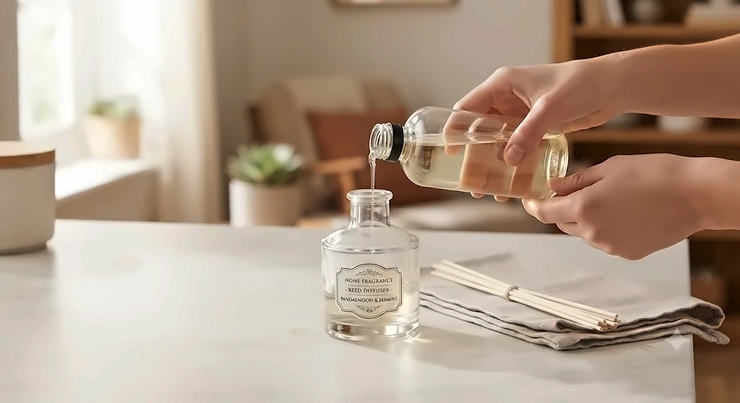
A reed diffuser oil refill is simply the scented liquid — usually a carrier oil blended with fragrance or essential oil — that you pour into an existing diffuser vessel once the original fill runs dry. No flame, no plug, no bulky cord snaking behind the credenza. Just quiet, continuous scent that works whether you’re renting a downtown Toronto condo where candles aren’t allowed or trying to keep a farmhouse in rural Manitoba smelling like something other than wet dog and woodsmoke.
Here’s what nobody tells you at the big-box store: not every refill fits every bottle, “concentration” on the label actually matters a lot more than the pretty packaging suggests, and the difference between a C$12 bottle and a C$45 bottle isn’t always what you’d assume. We dug into real product specs, aggregated genuine customer review sentiment, and Canadian safety guidance to build a research-backed guide — not a rewritten product listing. By the end, you’ll know exactly which bottle belongs on your shelf, and why.
Quick Comparison Table: Reed Diffuser Oil Refills at a Glance
| Product | Size | Style | Price Range (CAD) | Best For |
|---|---|---|---|---|
| Cocod’or Reed Diffuser Oil Refill | 200 ml | Fragrance oil | Around C$20-C$25 | Best all-rounder |
| SCENTORINI Lavender Reed Diffuser Refill | 200 ml | Natural essential oil blend | Under C$15 | Best budget pick |
| COCORRÍNA Cashmere Vanilla Refill | 200 ml | Fragrance oil | C$15-C$20 range | Best cozy scent |
| LA BELLEFÉE Fresh Linen Refill Oil | 200 ml | Fragrance oil + reeds bundle | C$15-C$20 range | Best bundle value |
| Airkeep Clean Linen Refill | 100 ml | Fragrance oil | Under C$15 | Best small-space pick |
| NEST New York Moroccan Amber Refill | 175 ml | Luxury fragrance oil | C$55-C$65 range | Best premium option |
| Lehood Natural Rattan Reed Sticks | 100-pack | Reed sticks only | Under C$15 | Best reed stick refill |
At a glance, the spread here tells its own story: you’re paying mostly for fragrance complexity and brand polish, not for dramatically different mechanics. A bargain 100 ml bottle and a luxury 175 ml bottle both rely on the same capillary action to pull oil up the reeds, a wicking process described in general terms on Wikipedia’s capillary action entry. What changes is how the oil is formulated — its viscosity, its fragrance load, and how cleanly it evaporates without leaving a sticky residue on your reeds. Budget picks tend to prioritize volume and value, while premium bottles like the NEST New York Moroccan Amber Refill lean on more expensive aromatic compounds and a slower, more layered scent throw.
💬 Just one click — help others make better buying decisions too!😊
Top 7 Reed Diffuser Oil Refills: Expert Analysis
We’ve sorted these seven real, currently available products across budget, mid-range, and premium tiers, plus a dedicated reed stick pick, so you’re covered no matter what’s sitting empty on your shelf right now.
1. Cocod’or Reed Diffuser Oil Refill — best all-rounder for consistent scent
The Cocod’or Reed Diffuser Oil Refill in White Jasmine has become something of a default recommendation, and there’s a clear reason for that: consistency. This is a 6.7 oz (200 ml) bottle, sold without reeds, meant purely as a refill you pour into your existing vessel or a spare glass container.
On paper this means you’re getting roughly double the volume of a typical starter diffuser set for a fraction of the price, which matters more than it sounds — most starter kits run out in six to eight weeks, and refilling instead of rebuying is where the real savings show up. Cocod’or states the fragrance is formulated to last up to 90 days per fill, and the company (a Korea-based global fragrance brand operating since 2002) develops its blends in-house rather than outsourcing to a generic contract fragrance house, which shows up in how balanced the scent feels rather than one-note-floral.
Based on the spec comparison against similar 200 ml competitors, this is the pick for anyone who wants a “set it and mostly forget it” refill that won’t overwhelm a mid-sized living room. Reviewers consistently report that the scent is noticeable without being cloying, though several noted that in larger open-concept spaces the fragrance can feel thinner than expected — a common trade-off with lighter-concentration oils. Aggregated feedback across thousands of ratings sits close to 3.9 out of 5, with the most frequent praise centred on value-per-ounce and the most frequent complaints tied to scent throw in bigger rooms.
Pros:
- ✅ Generous 200 ml bottle lasts noticeably longer than typical kits
- ✅ Formulated without trichloroethylene, toluene, or xylene
- ✅ Balanced, not overpowering, in small-to-mid rooms
Cons:
- ❌ Scent throw weakens noticeably in large open spaces
- ❌ Reeds sold separately, adding a small extra cost
At around C$20-C$25, the Cocod’or Reed Diffuser Oil Refill lands squarely in “buy two and don’t think about it again for months” territory — genuinely solid value for the volume you’re getting.

2. SCENTORINI Lavender Reed Diffuser Refill — best budget pick with natural oils
If your priority is stretching a household budget without switching to dollar-store air fresheners, the SCENTORINI Lavender Reed Diffuser Refill is worth a look. It ships in a 6.8 fl oz (200 ml) bottle and leans on a natural essential-oil-forward blend rather than a purely synthetic fragrance oil base.
What most buyers overlook about this model is that “natural essential oil” formulations tend to evaporate a little faster than heavier synthetic fragrance oils, which means the scent throw is often stronger in the first few weeks and mellows sooner — good news if you like a punchier initial fragrance, less good if you want a slow burn that lasts exactly 90 days on the dot. Aggregated review sentiment puts this in the mid-4-star range, with buyers frequently commenting on the true-to-lavender scent profile compared to synthetic dupes that smell more like air freshener than actual flowers.
This is the pick for renters, students, or anyone furnishing a first apartment on a tight budget who still wants their space to smell intentional rather than like nothing at all. It’s also a reasonable option for people sensitive to heavier synthetic fragrance blends, since essential-oil-forward formulas typically use fewer aroma chemicals per millilitre — though “natural” doesn’t automatically mean hypoallergenic, so anyone with diagnosed sensitivities should still patch-test before committing a whole bottle to their living room.
Pros:
- ✅ True-to-scent lavender rather than a synthetic approximation
- ✅ Lower price point than most 200 ml competitors
- ✅ Essential-oil-forward formula appeals to natural-leaning buyers
Cons:
- ❌ Faster fade rate than heavier synthetic fragrance oils
- ❌ Limited scent range compared to bigger fragrance houses
Priced under C$15, the SCENTORINI Lavender Reed Diffuser Refill is an easy way to test whether reed diffusers are even your thing before committing to pricier bottles.
3. COCORRÍNA Cashmere Vanilla Reed Diffuser Refill — best cozy, warm-weather scent
The COCORRÍNA Cashmere Vanilla Reed Diffuser Refill sits right alongside Cocod’or as one of the most consistently repurchased options in this category, and the 6.7 oz (200 ml) format matches the industry-standard bottle size, meaning it fits into most existing diffuser vessels without any awkward pouring or funnel gymnastics.
Here’s what the spec sheet won’t tell you, but user reports suggest: cashmere-vanilla-style blends (a warm, slightly powdery vanilla note layered with musk) tend to perform better in bedrooms and smaller enclosed rooms than in high-traffic hallways, simply because the base notes need still air to build up before you notice them. Reviewers frequently describe the scent as “cozy” and “not too sweet,” which is a meaningful distinction — a lot of vanilla-forward diffuser oils tip into bakery-aisle territory, and this one apparently avoids that by leaning on musk rather than pure sugar-vanilla notes.
Based on the spec comparison with competing vanilla blends, this is the pick for anyone decorating a bedroom, reading nook, or home office where a subtler, layered fragrance matters more than sheer projection. Families with young kids or pets in smaller condos also tend to gravitate here, since the scent profile reads as “warm home” rather than “perfume counter.”
Pros:
- ✅ Balanced vanilla-musk blend avoids overly sweet, bakery-like notes
- ✅ Standard 200 ml size fits most existing diffuser vessels
- ✅ Performs especially well in smaller, enclosed rooms
Cons:
- ❌ Less effective scent throw in open hallways or large rooms
- ❌ Reed sticks not included in the base bottle
In the C$15-C$20 range, the COCORRÍNA Cashmere Vanilla Reed Diffuser Refill earns its spot for anyone who wants “cozy” over “loud.”
4. LA BELLEFÉE Fresh Linen Reed Diffuser Refill Oil — best bundle value
The LA BELLEFÉE Fresh Linen Reed Diffuser Refill Oil takes a different approach than most refills on this list: it actually includes natural reed sticks in the box alongside the 200 ml bottle, rather than assuming you already own a stash of reeds sitting in a drawer somewhere.
That single design choice matters more than it might seem. Buyers who are refilling for the very first time — meaning they don’t yet own reeds, or their old ones have gone gummy and unusable — save themselves a second purchase and a second shipping wait. On paper this means better total value even if the per-bottle price looks similar to competitors, since you’re not quietly paying twice. LA BELLEFÉE also offers this refill across nine different scent and size variants, which gives buyers more room to match fragrance to room type without switching brands entirely.
What most buyers overlook about “fresh linen” style fragrances specifically is that they’re formulated to smell clean and slightly powdery rather than floral or gourmand, which makes them one of the more universally tolerated scent families for shared spaces — living rooms, entryways, guest bathrooms — where you’re diffusing for multiple people with different fragrance preferences, not just yourself.
Pros:
- ✅ Reed sticks included, so you’re refill-ready out of the box
- ✅ Nine scent and size variants for flexible room matching
- ✅ “Fresh linen” profile is broadly tolerated in shared spaces
Cons:
- ❌ Included reeds are lower-grade than premium rattan alternatives
- ❌ Some variants run slightly pricier than comparable single-scent bottles
At roughly C$15-C$20, the LA BELLEFÉE Fresh Linen Reed Diffuser Refill Oil is the smart first purchase for anyone starting completely from scratch.
5. Airkeep Clean Linen Reed Diffuser Oil Refill — best small-space, small-batch pick
Not every space needs a 200 ml bottle sitting around for months. The Airkeep Clean Linen Reed Diffuser Oil Refill comes in a 3.38 oz (100 ml) format — roughly half the standard size — which is a deliberate advantage for bathrooms, powder rooms, closets, and other small enclosed spaces where a full-size bottle would just sit half-used and gradually oxidizing on a shelf.
Based on the spec comparison against 200 ml competitors, smaller-format oils like this one actually perform better in tight spaces because the fragrance doesn’t need to work as hard to fill the air — a little goes further in 50 square feet than it does in an open-concept kitchen-living room combo. Reviewers frequently mention using this specifically in ensuite bathrooms and small home offices rather than main living areas, which tracks with how the format is designed.
What the spec sheet won’t tell you, but real-world use suggests, is that smaller bottles are also a smart way to sample a new scent family before committing to a full 200 ml size — if “clean linen” turns out not to be your thing, you’ve only spent on a half-size bottle, not a full one.
Pros:
- ✅ Compact 100 ml format ideal for bathrooms and small rooms
- ✅ Lower upfront cost makes scent-testing more affordable
- ✅ Clean, laundry-fresh scent profile works well in utility spaces
Cons:
- ❌ Runs out faster than 200 ml options if used in larger rooms
- ❌ Cost-per-millilitre is slightly higher than bulk-format bottles
At under C$15, the Airkeep Clean Linen Reed Diffuser Oil Refill is the practical choice for anyone diffusing room-by-room rather than house-wide.

6. NEST New York Moroccan Amber Reed Diffuser Refill — best premium, gift-worthy option
At the top of this list sits the NEST New York Moroccan Amber Reed Diffuser Refill, a 5.9 fl oz (175 ml) bottle from a fragrance house better known for department-store home fragrance than budget refills — and the price tag reflects that positioning clearly.
Here’s what the spec comparison actually shows: despite a smaller total volume than the 200 ml budget options on this list, NEST’s Moroccan Amber blend is built around a more complex, layered fragrance structure — warm amber resin, spice notes, and a smoky base — that reads as noticeably more expensive-smelling than single-note synthetic blends. Aggregated review sentiment sits around 4.7 out of 5 across the retail listings we reviewed, with buyers repeatedly describing the scent as “sophisticated” and comparing the room presence favourably to boutique hotel lobbies.
Reviewers consistently note that the scent throw is stronger and more consistent over time than budget alternatives, which honest analysis suggests comes down to a higher concentration of aromatic compounds relative to carrier oil — you’re paying for ingredient quality, not just brand markup. This is the pick for entryways, formal living rooms, or as a genuinely impressive housewarming gift, but it’s a hard sell for a college dorm room or a space where the diffuser might get knocked over during a move.
Pros:
- ✅ Complex, layered amber fragrance reads as noticeably upscale
- ✅ Stronger and more consistent scent throw over time
- ✅ Elegant bottle design doubles as a decor piece
Cons:
- ❌ Meaningfully higher price-per-millilitre than every other pick here
- ❌ Smaller 175 ml volume than most budget 200 ml competitors
Landing in the C$55-C$65 range, the NEST New York Moroccan Amber Reed Diffuser Refill is a splurge — but for the right room, it’s a justified one.
7. Lehood Natural Rattan Reed Diffuser Sticks — best reed stick refill pack
Every refill oil in the world is useless without functional diffuser reed sticks, and this is the piece people forget to replace far too often. The Lehood Natural Rattan Reed Diffuser Sticks pack includes 100 sticks at 3 mm diameter, offered in 8-inch, 10-inch, and 12-inch lengths to fit different bottle heights and room sizes.
What most buyers overlook about diffuser reed sticks specifically is that they’re not reusable indefinitely — natural rattan fibres clog with dust, oxidized oil residue, and evaporation byproducts over time, which is why fragrance seems to “die” even when there’s plenty of oil left in the bottle. Swapping in fresh reeds every four to six weeks, even with the same bottle of oil, restores scent throw dramatically because you’re replacing the clogged capillary channels rather than the fragrance itself.
Based on the spec comparison with synthetic fibre reeds sold by some diffuser brands, natural rattan sticks like these wick oil more consistently and don’t impart the faint plastic smell that lower-grade synthetic alternatives sometimes do near the top of the stick. Reviewers frequently note that buying reeds in bulk (100-count) works out to pennies per stick compared to the small 6-to-8-pack bundles sold with starter diffuser kits, which is a real cost advantage if you’re maintaining multiple diffusers around the house.
Pros:
- ✅ Bulk 100-count works out to a fraction of the cost per stick
- ✅ Three length options fit a wide range of bottle heights
- ✅ Natural rattan wicks oil more evenly than synthetic fibres
Cons:
- ❌ Requires trimming to size for shorter bottles
- ❌ Not scented or pre-treated, so it’s reeds only, no oil included
At under C$15 for a 100-pack, the Lehood Natural Rattan Reed Diffuser Sticks are the unglamorous but essential companion purchase most people don’t think about until their diffuser stops working.
How to Refill a Reed Diffuser: A Practical Usage Guide
Refilling sounds self-explanatory until you’re standing over your kitchen counter with an oil-stained funnel wondering why the new fragrance isn’t showing up after two days. Here’s the sequence that actually works, start to finish.
First, empty and rinse the vessel if you’re switching scents — even a small amount of leftover old oil will muddy a new fragrance for the first week or two, which is the single most common reason people think a new refill “isn’t working” when really it’s just fighting residual old scent. If you’re topping up the same scent, you can skip this step entirely and pour straight in.
Next, pour your reed diffuser refill oil to roughly 70-80% of the vessel’s capacity, leaving headroom so the reeds don’t overflow when you insert them. Fresh reeds matter here: if your existing sticks are more than six to eight weeks old, replace them rather than reusing clogged ones, since old reeds will bottleneck even a premium oil’s performance.
Insert 6 to 10 reeds depending on room size — more reeds means faster evaporation and stronger throw, fewer means a subtler, longer-lasting scent. Give the setup 24 to 48 hours before judging the fragrance strength; oils need time to fully wick up the reed length and reach the exposed tip where evaporation actually happens. Flip the reeds weekly (wet ends up, dry ends into the oil) to refresh the wicking surface, and keep the vessel away from direct sunlight or heating vents, both of which accelerate oxidation and shorten the useful life of the fragrance.
A quick maintenance rhythm — replace reeds every 4-6 weeks, top up oil as it depletes, and give the bottle a gentle swirl monthly to keep fragrance compounds from settling — is genuinely all that separates a diffuser that smells great for six months from one that fizzles out after three weeks.
✨ Ready to stock up? Browse today’s refill options before your current bottle runs dry!
Real-World Scenarios: Matching a Refill Oil to Your Space
Consider three genuinely different households, because the “best” reed diffuser oil refill really does depend on who’s buying it.
A university student in a 400-square-foot studio apartment in Halifax, working with a tight budget and a single small room, doesn’t need a 200 ml luxury bottle — the SCENTORINI Lavender Reed Diffuser Refill or the Airkeep Clean Linen Reed Diffuser Oil Refill covers the entire space easily, costs under C$15, and won’t feel like a waste if the student moves out in eight months and leaves half the bottle behind.
A young family in a suburban Calgary bungalow, trying to keep a shared living room and entryway smelling neutral and welcoming without triggering anyone’s sensitivities, does better with something like the LA BELLEFÉE Fresh Linen Reed Diffuser Refill Oil — a broadly tolerated, non-polarizing scent profile in a bundle that already includes reeds, which matters when you’re juggling groceries and a toddler and don’t want a second Amazon order for sticks.
A professional in a Vancouver condo who hosts regularly and wants the entryway to make a genuine impression is the exact customer NEST New York had in mind when they built the NEST New York Moroccan Amber Reed Diffuser Refill — a smaller, pricier bottle that punches well above its size in perceived quality, which is precisely the point when the goal is ambiance over economy.
None of these buyers are wrong. They’re solving different problems with the same basic tool, and matching the refill to the actual use case — not just the prettiest label — is what separates a diffuser you love from one gathering dust by month two.
Refill Compatibility Problems (And How to Solve Them)
This is where most first-time buyers get tripped up, so let’s walk through the real issues.
Problem: the new oil is a different brand than the original diffuser set. This is almost never actually an issue — a compatible diffuser refill doesn’t need to match the original brand at all, since reed diffusers are a purely mechanical wicking system, not a proprietary cartridge like a printer ink pod. Any fragrance oil formulated for reed diffusion will work in any open-neck glass or ceramic vessel, regardless of brand.
Problem: the oil is too thick and won’t wick up the reeds. Refill compatibility issues here usually trace back to viscosity, not brand. Thicker oils (some heavily fragranced or poorly formulated blends) struggle with capillary action, the same physical process that pulls water up a paper towel. If you notice reeds staying dry at the top after 48 hours, the oil is likely too viscous for efficient wicking — switching to a thinner, better-formulated fragrance oil solves this more reliably than adding more reeds.
Problem: the vessel’s neck opening is too wide or too narrow. A narrow neck traps fragrance and slows evaporation, extending scent life but reducing throw; a wide neck does the opposite. If you’ve bought a compatible diffuser refill oil but the scent seems either too weak or fades unusually fast, check whether you’re using the original narrow-neck bottle or a repurposed wide-mouth jar — the mismatch, not the oil, is often the culprit.
Problem: the fragrance seems to disappear within days. This is rarely a true compatibility problem and almost always a reed problem — clogged, oxidized reeds stop wicking properly regardless of how good the oil underneath them is. Swap the reeds before assuming the oil itself is defective.
How to Choose Diffuser Oil Bottles
The bottle matters more than most buyers assume, and it’s worth thinking through deliberately rather than grabbing whatever’s cheapest.
- Check the neck width first. Diffuser oil bottles with narrow necks (roughly 1-2 cm) slow evaporation and stretch out how long a single fill lasts, which suits people who want low-maintenance, long-lasting scent over maximum intensity.
- Consider glass over plastic where possible. Glass diffuser oil bottles don’t leach or interact with fragrance oils over time the way some plastics can, and they tend to look better as a permanent decor object rather than something you hide.
- Match bottle height to reed length. A tall, narrow bottle needs longer reeds (10-12 inches) to reach comfortably above the rim; a short, squat bottle works better with 6-8 inch reeds.
- Look for a stable, wide base. This sounds minor until a diffuser tips over on a bookshelf — a wide base relative to bottle height reduces that risk significantly, especially in homes with kids or pets.
- Factor in refill volume compatibility. A 100 ml refill poured into an oversized 300 ml vessel leaves too much headroom and dry reeds; match refill size to bottle size as closely as you reasonably can.
- Decide if you want to see the oil level. Clear or lightly tinted diffuser oil bottles let you monitor levels at a glance; opaque ceramic vessels look elegant but require occasionally checking by lifting or shaking.
- Think about where it’s going. A bathroom counter can handle a smaller, simpler bottle; an entryway console table is where a taller, more decorative bottle earns its visual keep.
What most buyers overlook here is that the bottle is a long-term investment separate from the oil itself — a good glass vessel can outlast a dozen refill cycles, which is exactly why products like LA BELLEFÉE Fresh Linen Reed Diffuser Refill Oil bundling reeds in with the oil is genuinely convenient, but the vessel itself is worth buying once and refilling for years.

Understanding Oil Concentration: What the Label Percentage Really Means
Oil concentration is the single most misunderstood spec on a reed diffuser oil refills label, and it deserves a proper explanation rather than a marketing footnote.
Reed diffuser formulas are essentially a ratio of carrier oil (often fractionated coconut oil, a lightweight, odorless base chosen because it’s thin enough to wick efficiently and stays liquid at room temperature) to concentrated fragrance oil. A typical home-fragrance formula runs somewhere between 15% and 30% fragrance oil concentration, with the remainder being carrier. Higher concentration generally means stronger, longer-lasting scent throw — but also a higher price, since fragrance oil is the expensive ingredient and carrier oil is comparatively cheap filler.
Here’s what the spec sheet won’t tell you, but formulation basics make clear: a bottle advertising “extra strength” or “long-lasting” is very likely just describing a higher oil concentration blend, not some proprietary technology. Reviewers consistently note that premium brands like NEST New York deliver noticeably stronger, more consistent scent throw specifically because their concentration ratios skew higher than budget competitors — which is a legitimate reason for the price gap, not just brand markup.
For most living spaces, a mid-concentration formula in the 20-25% range hits the sweet spot between noticeable presence and not overwhelming guests or triggering anyone with fragrance sensitivities. If a product doesn’t list its concentration at all, that’s not necessarily a red flag, but it does mean you’re relying more heavily on aggregated review sentiment about scent strength rather than a hard number — which is exactly why we’ve flagged real reviewer feedback on throw and longevity throughout this guide.
Diffuser Reed Sticks: Material, Count & Replacement Guide
Diffuser reed sticks get almost no attention compared to the oil itself, which is a mistake, because they’re doing all the mechanical work.
Natural rattan is the gold standard, prized for its consistent internal channel structure that draws oil upward through capillary action efficiently and evenly. Synthetic fibre reeds exist too, usually cheaper and sometimes marketed as “no-mess” or reusable, but reviewers frequently note they wick less consistently and can occasionally carry a faint plastic scent that competes with the fragrance oil itself, particularly noticeable in the first few days of use.
Diameter matters more than most buyers realize: thinner reeds (around 3 mm, like those in the Lehood Natural Rattan Reed Diffuser Sticks pack) wick faster and produce a stronger initial throw, while thicker reeds wick more slowly for a subtler, longer-lasting release. Length should roughly match one and a half times the bottle height, giving enough reed exposed above the rim for evaporation while keeping enough submerged for steady capillary draw.
Replacement frequency is the part almost nobody budgets for. Reeds should be swapped every 4-6 weeks even if oil remains in the bottle, since oxidized residue and dust accumulation clog the wicking channels over time — buying reeds in bulk, as opposed to the small 6-8 packs bundled with starter kits, meaningfully lowers the long-term cost of maintaining a diffuser, which is exactly the value proposition behind a 100-count pack.
Reed Diffuser Refill Oil vs DIY Homemade Diffuser Blends
There’s a genuine cottage industry of people making their own reed diffuser refill oil at home, typically blending fractionated coconut oil, a splash of high-proof vodka to thin the mixture, and essential oils in roughly a 70:20:10 ratio. It’s worth weighing honestly against buying a pre-made bottle.
| Factor | Pre-Made Refill Oil | DIY Homemade Blend |
|---|---|---|
| Upfront cost | Higher per bottle | Lower per batch |
| Time investment | None — pour and go | 20-30 minutes to mix and test |
| Scent consistency | Professionally balanced | Trial-and-error until dialed in |
| Ingredient control | Limited to label disclosure | Full control over every ingredient |
| Best for | Convenience-focused buyers | Hobbyists and fragrance-sensitive households |
Looking at the comparison above, pre-made options like the Cocod’or Reed Diffuser Oil Refill win decisively on convenience and consistency — professional perfumers have already solved the ratio problem for you. DIY blending wins on ingredient transparency and customization, which matters a lot to households managing specific fragrance sensitivities who want to control exactly what’s in the bottle down to the drop. Cost-wise it’s genuinely close once you account for the price of quality essential oils and a bottle of vodka, so this decision usually comes down to how much you value your own time versus creative control.
Common Mistakes When Buying Reed Diffuser Oil Refills
A few patterns show up again and again in aggregated review complaints, and most are avoidable with a little foresight.
Buying based on the label description alone, without checking size, is probably the most common misstep — a “great value” bottle that’s actually 50 ml looks cheap until you calculate cost-per-millilitre against a 200 ml competitor. Ignoring reed condition is another: buyers frequently blame the oil for weak scent throw when six-week-old clogged reeds are the actual problem, an easy C$10 fix that gets misdiagnosed as a bad oil purchase.
Choosing based purely on scent name without reading concentration or reviewer feedback on throw is another trap — “Ocean Breeze” means something different to every fragrance house, and the only reliable signal is aggregated real-world feedback, not the name on the label. Finally, buying a single scent for the entire home is a subtle mistake; what works beautifully in a small bathroom can feel overwhelming in an open-concept living space, which is exactly why matching bottle size and concentration to room size, as covered earlier, makes such a meaningful difference.
What to Expect: Real-World Scent Performance
Specs on a label are one thing; how a diffuser actually behaves in your living room is another. In the first 24-48 hours after a fresh fill, expect a noticeable “top note” burst as the reeds initially saturate — this early phase is usually the strongest the scent will smell, so don’t judge long-term performance from day one alone.
Over the following weeks, expect a gradual mellowing as base notes take over from brighter top notes, which is normal fragrance evolution, not a sign of a defective product. Room size dramatically changes perceived strength: the same bottle that fills a bathroom in twenty minutes might feel barely noticeable in an open-concept kitchen-living space, which is why matching concentration and reed count to your actual square footage, not just following generic instructions, produces the best real-world results.
Airflow matters more than most buyers expect, too — a diffuser near an air vent, ceiling fan, or frequently opened window will disperse scent faster and fade sooner than one tucked into a still corner, even with identical oil and identical reeds.
Long-Term Cost & Maintenance: Is Refilling Actually Cheaper?
Running the actual numbers helps settle a question a lot of buyers only half-think through: is buying reed diffuser refill oil genuinely cheaper than starting fresh with a new diffuser set each time?
A starter kit with vessel, reeds, and oil typically runs C$25-C$40 and includes maybe 100 ml of oil and a handful of reeds. A 200 ml refill bottle like the Cocod’or Reed Diffuser Oil Refill costs roughly C$20-C$25 — double the oil volume for a similar or lower price, since you’re not paying for a new glass vessel every time. Add a bulk reed pack like the Lehood Natural Rattan Reed Diffuser Sticks at under C$15 for 100 sticks, enough for roughly eight to ten reed replacements across a full year of maintenance, and the total cost of ownership drops sharply after the first purchase.
Over a 12-month period diffusing continuously in one room, a household buying refills and bulk reeds typically spends noticeably less than one repeatedly purchasing new starter kits, while also generating less packaging waste — a modest but real environmental upside that doesn’t get discussed enough in this category.
Safety, Scent Sensitivities & Canadian Regulations
Reed diffusers are genuinely one of the lower-risk home fragrance methods — no open flame, no heating element, no electrical component — but “low risk” isn’t “no consideration needed,” especially in shared Canadian workplaces and multi-unit housing.
Scent sensitivities are a documented and increasingly recognized issue in Canadian workplaces specifically. The Canadian Centre for Occupational Health and Safety outlines a formal scent-free policy framework for employers managing fragrance-related complaints, noting that chemicals in scented products can trigger headaches, respiratory symptoms, and allergic reactions in sensitive individuals — genuinely worth keeping in mind if you’re considering a diffuser for a shared office or a multi-tenant building lobby rather than your own private space.
The Canadian Human Rights Commission goes further, framing environmental sensitivities as an accessibility issue under Canadian human rights law, and recommends proactive scent-free accommodations in workplaces and public-facing spaces. For home use this is less of a legal question and more of a courtesy one — if you’re diffusing in a shared apartment hallway or a rental with roommates, checking in before committing to a strong scent avoids an entirely avoidable conflict.
Basic handling precautions still apply regardless of concentration: keep bottles out of reach of small children and pets, since concentrated fragrance oils can cause irritation if ingested or splashed in eyes, avoid placing diffusers on surfaces that could stain from a spill (fragrance oils can mark unsealed wood or fabric), and store spare bottles away from direct heat or sunlight to preserve fragrance stability. None of this makes reed diffusers unsafe — it just makes them worth handling with the same basic care you’d give any concentrated household product.

FAQ: Reed Diffuser Oil Refills
❓ Can I put any reed diffuser refill oil into any diffuser bottle?
❓ How long does a 200 ml reed diffuser oil refill last?
❓ Why did my diffuser stop smelling even though there's still oil left?
❓ Is a higher oil concentration always better?
❓ Can I mix leftover reed diffuser refill oil from two different bottles?
Conclusion
Reed diffuser oil refills solve a genuinely small but persistently annoying problem: keeping your home smelling like an intentional choice rather than whatever the last cooking session or wet-boots-by-the-door situation left behind. The seven real products covered here span the full range a Canadian household actually needs — the Cocod’or Reed Diffuser Oil Refill as a dependable all-rounder, the SCENTORINI Lavender Reed Diffuser Refill and Airkeep Clean Linen Reed Diffuser Oil Refill for tighter budgets and smaller spaces, the COCORRÍNA Cashmere Vanilla Refill and LA BELLEFÉE Fresh Linen Refill Oil for cozy mid-range everyday use, the NEST New York Moroccan Amber Refill for genuine luxury, and the Lehood Natural Rattan Reed Diffuser Sticks for the maintenance piece almost everyone forgets.
What actually separates a diffuser you love from one gathering dust is rarely the brand name — it’s matching bottle size, oil concentration, and reed freshness to your specific room, and staying on top of the simple maintenance rhythm covered above. Get those pieces right, and a reed diffuser becomes one of the lowest-effort ways to make a Canadian home feel genuinely cared for, one quiet capillary-action pull at a time.
Recommended for You
- Masculine Scented Candles: 7 Best Whiskey; Woodsy Picks
- Best Reed Diffuser 2026: 7 Top Picks From Budget to Luxury
- Candles That Burn 50 Hours: 7 Best Long-Lasting Picks (2026)
Disclaimer: This article contains affiliate links. As an Amazon Associate, I earn from qualifying purchases. If you purchase products through these links, we may earn a small commission at no additional cost to you.
✨ Found this helpful? Share it with your friends! 💬🤗
