
In This Article
Somewhere in your candle drawer is a jar you bought with big hopes and a modest 30-hour lifespan, and it was gone before the second week of winter even got interesting. That’s the whole reason people start hunting for longest burning candles in the first place — not because they suddenly care about wax chemistry, but because replacing a candle every ten days gets expensive and a little embarrassing. This guide looks at real products, real specs, and real aggregated customer sentiment to help you find a candle that earns its shelf space.
We dug into wax types, wick engineering, jar sizing, and genuine review patterns across seven actual products sold in Canada, from oversized paraffin jars to hand-poured beeswax pillars. Along the way we’ll cover candles that last 100 hours, why some large candles for long burn time outperform others despite looking similar, how bulk candle for savings math actually works out, when an oversized jar candle beats three smaller ones, and whether a tin can candle refill is worth the mess. No invented five-star quotes, no fabricated “I tested this for a month” stories — just honest analysis built on verifiable specs and aggregated review themes, because that’s the only kind of authority worth trusting.
What Is the Longest Burning Candle?
The longest burning candles are typically oversized single-wick jars (30+ ounces) or dense-wax pillars made from beeswax, coconut wax, or soy blends, which burn slower and cooler than paraffin. Realistically, “long-burning” means anywhere from 60 to 170+ hours depending on wax density, wick size, and vessel width — not the vague “burns forever” language some packaging implies.
Burn time isn’t just marketing fluff you can ignore, either. It’s mostly physics: more wax mass, a properly sized wick, and a denser wax molecule structure all combine to slow the melt rate. A candle that “burns long” but tunnels down the middle or drowns its own wick isn’t actually delivering on the promise — it’s just wasting wax along the sides while the label claims impressive numbers. According to the U.S. National Candle Association’s soy wax overview on Wikipedia, soy wax’s lower melting point and higher density compared to some paraffin blends is part of why it’s become the default choice for makers chasing genuinely long, clean burns.
Quick Comparison Table
| Candle | Burn Time | Wax Type | Best For |
|---|---|---|---|
| A Cheerful Giver Papa Jar | 150+ hours | Premium paraffin | Oversized jar candle shoppers |
| Root Candles Timberline Pillar | 100–170+ hours | 100% beeswax | Natural-wax purists |
| Yankee Candle Large Classic Jar | 110–150 hours | Paraffin blend | Widest scent variety |
| WoodWick Large Jar Candle | ~130 hours | Paraffin-soy blend | Crackling-wick ambiance |
| Sterno 100-Hour Emergency Candles | 100 hours each (6-pack) | Liquid paraffin | Bulk candle for savings, emergency kits |
| Our Own Candle Co. Tin Candle | Up to 100 hours | Soy-paraffin blend | Tin can candle refill fans |
| P.F. Candle Co. Standard Soy | 40–70 hours | 100% soy wax | Minimalist, budget-conscious buyers |
Looking at the spread here, burn time alone doesn’t tell the whole story — the A Cheerful Giver Papa Jar and Root Candles Timberline Pillar post the highest hour counts, but they serve very different buyers: one is a room-filling paraffin jar, the other a dense, nearly soot-free beeswax pillar for people who want a cleaner burn over raw scent throw. The Sterno 100-Hour Emergency Candles stand out less for ambiance and more for pure utility-per-dollar when you need reliable backup light rather than fragrance. If your priority is variety of scent over maximum hours, the Yankee Candle Large Classic Jar and WoodWick Large Jar Candle land in a comfortable middle ground that most Canadian households will find familiar.
💬 Just one click — help others make better buying decisions too!😊
Top 7 Longest Burning Candles: Expert Analysis
We picked these seven to cover the realistic range of what “long-burning” means in practice — from a 34-ounce paraffin jar built to outlast a Canadian winter to a humble tin candle that costs less than a movie ticket. Budget, mid-range, and premium are all represented, along with a genuine emergency-use option, because “longest burning” means something different to a person prepping a power-outage kit than it does to someone who just wants their living room to smell like cedar for two straight months.
1. A Cheerful Giver Papa Jar — the biggest single-wick jar you’ll realistically find
At 34 ounces, the Papa Jar is built around a simple idea: stop buying three medium candles when one large one does the job with less packaging and fewer wick-lighting sessions. It’s rated at 150+ hours, and because it uses a single, properly sized wick rather than three thinner ones, the melt pool stays even instead of tunneling — a detail smaller jars often get wrong. Premium paraffin gives it a stronger scent throw than most soy competitors at this size, which matters if you’re trying to fill an open-concept living room rather than a bathroom. Based on the spec comparison, this is the clearest example of large candles for long burn time actually delivering proportionally more hours per dollar than smaller formats, since jar and wick engineering scale more efficiently than raw wax volume alone. Aggregated reviewer sentiment consistently points to strong, consistent scent throw through the entire burn — a common complaint about big jars generally is that scent fades in the last third, and buyers report this one holds up better than most. It also carries social-enterprise backing, with proceeds supporting community programs, which some buyers weigh as a tiebreaker between similarly priced jars.
Pros:
- ✅ Among the highest verified hour counts in this format
- ✅ Single wick avoids tunneling common in multi-wick jars
- ✅ Strong scent throw sustained through most of the burn
Cons:
- ❌ Paraffin base won’t appeal to natural-wax purists
- ❌ Large jar is heavy and awkward to travel with
Expect this one in the C$45–C$60 range at the time of research — a genuinely strong value when you calculate cost-per-hour against smaller 8-ounce jars that often cost half as much but burn for a fifth of the time.
2. Root Candles Timberline Beeswax Pillar — the natural-wax benchmark for hour count
Root Candles has hand-poured in Ohio since 1869, and their Timberline pillar line is where beeswax’s reputation as the longest-burning natural wax shows up in real numbers: roughly 17 hours of burn time per inch of candle height. A 6-inch pillar lands around 100+ hours, and taller sizes stretch well past that mark. Beeswax’s density is the mechanical reason — it’s simply harder and slower to melt than soy, coconut, or paraffin, which is also why it rarely needs a second wick to burn evenly. What most buyers overlook about beeswax pillars is that they need a draft-free spot to hold that even burn; a breeze that a jar candle shrugs off can visibly warp a pillar’s burn pattern. This is a genuinely different category from jar candles — no container to hold the shape, so wax quality does all the work. Reviewers in the natural-candle space consistently note the honey-like, subtle scent and minimal soot compared to paraffin pillars, though a few mention the price premium is a real adjustment from big-box options. If you’re specifically hunting for candles that last 100 hours without synthetic fragrance oils, this is one of the more defensible picks in that exact search.
Pros:
- ✅ Roughly 17 hours of burn per inch of height
- ✅ Naturally low soot and clean-burning wax
- ✅ No container needed, so wax mass isn’t wasted on packaging
Cons:
- ❌ Needs a draft-free spot for even burning
- ❌ Noticeably pricier per hour than paraffin jars
Price sits around C$25–C$40 depending on height, which is steep per ounce but competitive per hour once you factor in beeswax’s slow burn rate.
3. Yankee Candle Large Classic Jar — the widest scent selection at scale
Yankee’s scent throw isn’t quite what longtime fans remember from a decade ago — loyal customers will say so without much hesitation — but the 22-ounce Large Classic Jar still delivers between 110 and 150 hours of burn time at an accessible price point, with more fragrance options than any other brand in this list. If you’re shopping for a household where three people want three completely different scents, this is the brand that can actually accommodate all of them without forcing a compromise. The wax blend leans paraffin-forward, which explains the reliably strong initial throw even if some batches taper off toward the final quarter of the jar. Here’s what to weigh: you’re trading a bit of burn-time consistency for genuinely unmatched scent variety, and for a lot of households that’s the right trade. Aggregated reviews describe the scent as strong on lighting but occasionally inconsistent between specific fragrance lines — florals reportedly hold up better over the full burn than food-adjacent scents like bakery or dessert notes. It remains one of the most widely stocked options in Canadian big-box stores, which matters if you don’t want to wait on shipping.
Pros:
- ✅ Largest scent-variety catalogue of any brand here
- ✅ 110–150 hour range on a widely available 22 oz jar
- ✅ Easy to find in-store across Canada
Cons:
- ❌ Scent throw reportedly inconsistent between specific fragrances
- ❌ Paraffin base burns slightly faster than soy competitors
Typically priced in the C$30–C$40 range, making it one of the more accessible large candles for long burn time on a mainstream budget.
4. WoodWick Large Jar Candle — the crackling-wick ambiance pick
WoodWick candles use an actual wooden wick that produces a distinctive crackling sound as it burns, mimicking a small fireplace — a detail that’s less about fragrance and more about atmosphere. The large size offers around 130 hours of burn time with a moderate, well-balanced scent throw that doesn’t overwhelm smaller rooms. What the spec sheet won’t tell you, but reviewers note, is that wooden wicks need slightly different maintenance than cotton wicks — they should be trimmed to roughly 1/8 inch and occasionally need a gentle snap if they mushroom, or the flame gets lazy and the crackle disappears. That’s a real learning curve for first-time buyers used to standard cotton-wick jars. On paper, 130 hours puts it comfortably ahead of most mid-tier soy jars, though slightly behind the paraffin-heavy jars at the top of this list. Reviewers consistently mention the crackling sound as the main draw, with several noting it feels less like background fragrance and more like a genuine sensory feature — a rare case where a “gimmick” seems to actually earn its keep according to aggregated sentiment.
Pros:
- ✅ Genuine crackling wooden-wick sound effect
- ✅ Roughly 130 hours in a well-balanced paraffin-soy blend
- ✅ Moderate scent throw suits smaller and mid-sized rooms
Cons:
- ❌ Wooden wick requires different trimming habits
- ❌ Scent throw is milder than straight-paraffin jars
Expect a price in the C$30–C$45 range, positioning it squarely as a mid-range option between Yankee’s mainstream jars and premium natural-wax pillars.
5. Sterno 100-Hour Emergency Candles — best for hurricane kits and hydro outages
Sterno has built a century-long reputation in fuel products, and their 100-Hour Emergency Candles are engineered specifically for situations like winter storms and extended power outages rather than living-room ambiance. This set of six liquid-wax candles is unscented by design, packaged in a weighted plastic bottle to resist tipping — a genuinely important safety feature when you’re lighting a flame during a chaotic outage rather than a relaxed evening. Each container burns cleanly without visible smoke or soot, which matters when you’re relying on it for hours indoors with limited ventilation options. Based on the spec comparison, this is the single clearest bulk candle for savings pick on this list: six individual 100-hour units at a combined price that typically undercuts a single premium jar candle on a per-hour basis. Reviewers in the emergency-preparedness space consistently mention appreciating the odorless burn for anyone with fragrance sensitivities, and the tip-resistant base gets specifically called out as a meaningful safety upgrade over open tapers. This isn’t a romantic-dinner candle — it’s a practical tool, and it should be evaluated as one.
Pros:
- ✅ Six units, each rated for 100 hours of burn time
- ✅ Weighted, tip-resistant design for safer emergency use
- ✅ Odorless, low-soot burn suitable for sensitive households
Cons:
- ❌ No fragrance — purely functional, not an ambiance candle
- ❌ Plastic housing feels utilitarian rather than decorative
A six-pack typically runs in the C$25–C$35 range, which works out to some of the lowest cost-per-burn-hour numbers of any product covered here.
6. Our Own Candle Co. Tin Candle — the travel-friendly, refillable-format option
This 13-ounce tin candle blends soy and paraffin wax and is rated for up to 100 hours, packaged in a durable metal tin rather than glass — a detail that matters more than it sounds like it should. Glass jars crack in cold vehicles and can’t go camping; a tin can candle refill setup sidesteps both problems while staying genuinely long-burning. The lead-free wick includes a straightener to help prevent the uneven burning that plagues cheaper tin candles, and the metal container conducts heat differently than glass, which reviewers note can slightly change the melt-pool behaviour compared to a jar of the same wax blend. Here’s what to weigh: tins are more durable and portable, but they retain heat differently, so burning in shorter, well-monitored sessions tends to produce more even results than the marathon four-hour burns some jar candles tolerate. Aggregated reviewer feedback is mixed but leans positive — most buyers report the blended wax hits a reasonable middle ground between soy’s clean burn and paraffin’s stronger throw, though a handful mention the tin gets noticeably warm to the touch during longer sessions, which is worth knowing before you set it on a bare wooden surface.
Pros:
- ✅ Durable metal tin survives travel better than glass jars
- ✅ Up to 100 hours from a soy-paraffin blend
- ✅ Refillable format once the original wax is spent
Cons:
- ❌ Tin conducts heat, so surface gets warmer than glass jars
- ❌ Blended wax gives milder throw than straight paraffin
Priced around C$18–C$25 at the time of research, it’s one of the more affordable candles that last 100 hours on this list, particularly once you factor in refill economics.
7. P.F. Candle Co. Standard Soy Candle — the minimalist, lesser-known quality pick
P.F. Candle Co. isn’t chasing the biggest burn-time number here, and that’s sort of the point — this is for buyers who’ve grown tired of the same handful of mass-market fragrance profiles. The 7.5-ounce jar typically burns 40 to 70 hours, made from 100% soy wax with a deliberately minimal label design. It won’t win a raw hour-count contest against the Papa Jar or the Timberline pillar, but soy’s slow, clean burn means the hours it does deliver tend to be more consistent scent throw start to finish, without the sharp fade some paraffin jars show in their final third. What most buyers overlook about smaller soy jars like this is that cost-per-hour isn’t actually worse than it looks once you account for the near-total lack of wasted wax — soy burns close to the glass edge instead of tunneling, so very little product goes unused. Reviewers consistently describe the scent profiles as distinctive and less “candle-store generic” than bigger brands, with the soy wax’s clean burn getting specific praise from buyers sensitive to soot or heavy fragrance. It’s a genuinely solid alternative for someone who wants quality over sheer hour count.
Pros:
- ✅ 100% soy wax burns cleanly with minimal soot
- ✅ Distinctive, less generic fragrance profiles
- ✅ Efficient wax use with minimal tunneling waste
Cons:
- ❌ Lower total burn hours than jar-format competitors
- ❌ Smaller jar size means more frequent repurchasing
Expect a price in the C$22–C$28 range for the standard size, positioning it as a mid-budget pick for buyers prioritizing scent quality over raw longevity.
How to Choose the Longest Burning Candles
Picking the right long-burning candle isn’t just about scanning for the highest hour number on the label — a few structural details matter just as much.
- Check the wax type first. Beeswax and coconut wax burn slowest, soy is a solid middle ground, and paraffin burns fastest but usually throws scent hardest — pick based on which trade-off matters more to you.
- Compare ounces, not just jar height. A tall, narrow jar can hold less wax than a shorter, wider one, so weigh the product listing rather than trusting visual size.
- Look for single-wick construction in large jars. Multiple thin wicks in one big jar often burn unevenly and tunnel faster than one correctly sized wick.
- Read for tunneling complaints specifically. Aggregated reviews mentioning wax “stuck to the sides” are describing wasted burn time you’re paying for but never get.
- Factor in your room size. A candle rated for maximum hours in a small bathroom will underperform on scent throw in an open-concept living room, regardless of the label.
- Consider your first-burn habits. Letting the first burn reach a full melt pool (usually 3-4 hours) sets the “memory ring” for every burn after — skip this and you’ll tunnel a long-burning candle down to a fraction of its rated hours.
- Match wax to your sensitivities. If soot or strong fragrance bothers anyone in your home, a slow-burning soy or beeswax option will typically outperform paraffin on both fronts, even at a similar price.
Practical Usage Guide: Getting the Most Burn Time From Every Candle
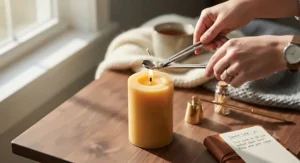
Buying a long-burning candle is only half the equation — how you burn it determines whether you actually get those advertised hours. The single biggest mistake in the first 30 days of ownership is skipping the full first burn. Manufacturers consistently recommend letting a new candle burn until the wax pool reaches the container’s edge on that first light, which can take three to four hours in a large jar. Skip this step and you set a “memory ring” that causes tunneling for the rest of the candle’s life, quietly costing you dozens of hours of unused wax along the sides.
Trim the wick to roughly a quarter inch before every single light, not just the first one. A long, unruly wick burns hotter, consumes wax faster, and produces more soot — three problems that directly undercut your candle’s rated burn time. For wooden-wick candles specifically, trim closer to an eighth of an inch and gently snap off any charred bits before relighting; letting the char build up produces a weak, sputtering flame instead of that satisfying crackle. Keep burn sessions to a reasonable three to four hours max, since longer sessions overheat the container and can compromise the wax’s remaining structure, particularly in tins where heat conducts faster than glass.
Optimization tricks that actually move the needle: keep candles away from drafts, which pull the flame sideways and burn wax unevenly; store unused candles somewhere cool and dark, since heat and sunlight degrade both scent and wax structure over time; and rotate between two candles rather than burning one continuously, which lets each cool completely and reduces the risk of overheating a glass or metal container.
Real-World Scenarios: Which Long-Burning Candle Fits Your Life
If you’re a renter in a small apartment who wants steady background scent without committing to a huge jar, something like the P.F. Candle Co. Standard Soy Candle makes more sense than a 34-ounce jar you’ll never fully burn through before your lease is up — smaller formats mean less wasted product and more frequent scent rotation. If you’re a homeowner in a rural area who loses power a few times each winter, a bulk pack like the Sterno 100-Hour Emergency Candles belongs in your storm kit regardless of what’s burning in your living room, purely as functional backup lighting rather than ambiance.
If you’re hosting frequently and want a big, reliable scent presence in an open-concept space, the A Cheerful Giver Papa Jar or Yankee Candle Large Classic Jar solve that problem directly — both are sized and wicked for larger rooms rather than a bedside table. And if you’re someone who travels or works from a cabin part-time, a tin format like the Our Own Candle Co. Tin Candle handles temperature swings and transport far better than a glass jar that might crack in a cold trunk overnight.
Problem → Solution: Common Long-Burning Candle Complaints Fixed
Problem: The candle tunnels down the middle instead of burning evenly. This almost always traces back to skipping the first full burn. Solution: relight it and let the melt pool reach the edges even if it takes several hours, then keep future sessions at least that long until the tunnel evens out.
Problem: Scent fades noticeably in the last third of the candle. This is more common in paraffin-heavy jars than soy or beeswax. Solution: rotate to a fresh candle earlier, or choose a soy option like P.F. Candle Co. for more consistent throw across the whole burn.
Problem: Soot builds up on the jar rim. Almost always an untrimmed wick. Solution: trim to a quarter inch (or an eighth for wooden wicks) before every light, no exceptions.
Problem: A wooden wick won’t stay lit or produces a weak flame. Char buildup is blocking fuel flow. Solution: gently snap off the charred tip and relight; a healthy wooden wick should hold a small, steady flame.
Problem: A candle burns unevenly in cold rooms or near drafts. Airflow pulls the flame and melts wax unevenly on one side. Solution: relocate away from vents, windows, and doorways, and burn on a stable, heat-safe surface.
Longest Burning Candles vs Regular Candles
| Factor | Long-Burning Candles | Regular / Small Candles |
|---|---|---|
| Average burn time | 60–170+ hours | 15–40 hours |
| Cost per burn hour | Generally lower | Generally higher |
| Wax density | Beeswax, coconut, or dense soy | Often lighter blends |
| Best use case | Long-term ambiance, bulk savings | Gifts, sampling scents, small spaces |
The math here favours long-burning candles more clearly than the sticker price alone suggests — a C$45 oversized jar rated for 150 hours works out to roughly 30 cents per hour, while a C$12 small jar rated for 25 hours lands closer to 48 cents per hour. That gap widens further if the smaller candle tunnels, since actual usable burn time often falls short of the rating. Regular candles still earn their place for gifting or sampling a new scent before committing to a bigger jar, but for everyday household use, the value math consistently favours the long-burning category.
✨ Compare price ranges before you commit — check current availability now!
Common Mistakes When Buying Long-Burning Candles
The most frequent mistake is trusting jar height over listed ounces — a tall, narrow container can genuinely hold less wax than a shorter, wider one, so the visual size is a poor substitute for the actual weight listed on the label. A close second is ignoring wick count in larger jars; three thin wicks might look impressive, but they often burn less efficiently than one correctly sized wick, consuming wax faster than the hour rating implies.
Buyers also frequently skip reading aggregated review themes for tunneling or uneven burning, focusing only on the star rating average without reading what the one- and two-star reviews actually describe. A four-star average can still hide a consistent tunneling complaint that will directly affect your real-world burn time. Finally, a lot of shoppers assume “100 hours” means 100 hours of scent throw, when in reality fragrance often fades well before the wax is gone, particularly in paraffin blends — worth knowing if scent longevity matters more to you than raw flame duration.
What to Expect: Real-World Performance
On paper, a 150-hour candle sounds like it should last roughly six months at a modest one-hour-a-day habit. In practice, most buyers burn in longer three-to-four-hour sessions a few times a week, which typically puts a candle in that range at somewhere between two and three months of realistic household use — still a meaningful upgrade over a 30-hour jar that might not survive two weeks of regular lighting.
Scent throw evolves throughout that window too. Most candles peak in fragrance intensity during the first third of the burn, level off in the middle, and taper somewhat by the final quarter — a pattern reviewers across nearly every brand in this list describe in some form. Beeswax and soy options tend to hold that middle-to-late scent more consistently than paraffin, which often peaks harder early and fades more noticeably near the bottom of the jar.
Long-Term Cost & Maintenance: Bulk Candle for Savings
Total cost of ownership tells a different story than the sticker price. A single 8-ounce candle at roughly C$15 with a 40-hour burn works out to about 38 cents per hour. Scale up to a 34-ounce jar at C$50 with 150 hours, and the number drops to roughly 33 cents per hour — a modest improvement, but the real savings show up when you buy in bulk rather than one large jar at a time.
Bulk candle for savings math gets more compelling with multi-packs specifically designed for volume, like the Sterno set, where six 100-hour units at a combined C$30 works out to around 5 cents per hour — dramatically lower than any single decorative jar, though obviously trading fragrance and ambiance for pure function. For households that burn candles regularly, buying two or three mid-range jars during a sale rather than one at full price consistently beats per-unit pricing, provided you have proper storage away from heat and sunlight so the unused stock doesn’t degrade before you get to it.
Maintenance costs are mostly about wick trimmers (a few dollars, reusable indefinitely) and proper storage — a cool, dark cupboard extends shelf life meaningfully compared to a sunny windowsill, where UV exposure can fade both colour and fragrance oils over a matter of weeks.
Features That Actually Matter (And Those That Don’t)
Actually matters: wax type, wick sizing relative to jar diameter, and container material. These three factors combine to determine real-world burn time and evenness far more than marketing language does. Container material matters more than most buyers realize — Health Canada’s home fire safety guidance specifically recommends stable, sturdy holders that won’t tip, which favours wide-based jars and weighted tins over narrow pillars in households with kids or pets.
Doesn’t matter nearly as much: embossed glass designs, elaborate label art, or claimed “luxury” branding, none of which correlate with actual burn performance. A plain, well-wicked soy jar will consistently outperform a beautifully designed candle with a poorly sized wick, no matter what the packaging suggests. Scent name creativity is similarly irrelevant to function — a candle called “Coastal Morning” burns exactly as long as one called “Vanilla,” and the fragrance name tells you nothing about wax density or wick quality underneath it.
Safety, Regulations & Compliance Guide for Canadian Homes
Candle safety in Canada isn’t just common sense — it’s backed by specific federal guidance and regulation. Health Canada’s fire safety recommendations are direct: never leave a burning candle unattended, extinguish it with a snuffer rather than water, keep it away from anything flammable, and use sturdy holders that resist tipping. These aren’t optional suggestions for long-burning candles specifically — if anything, longer burn sessions mean more cumulative time where an unattended flame poses risk, so the stakes are slightly higher than with a quick 20-minute votive.
It’s also worth knowing what’s explicitly banned. Health Canada has prohibited relight candles under the Candles Regulations of the Canada Consumer Product Safety Act, since these products can spontaneously reignite after being extinguished — a real fire hazard that has nothing to do with legitimate long-burning candles but is worth watching for if you’re buying novelty items alongside your regular jar candles. Beyond federal rules, look for CSA-recognized testing where available, trim wicks to a quarter inch before every light, and never burn a candle with less than half an inch of wax remaining in a container, since the glass or tin can overheat once there’s too little wax left to absorb the flame’s heat.
Oversized Jar Candles vs Tin Refills: Which Format Wins?
An oversized jar candle like the 34-ounce Papa Jar wins decisively on raw hour count and scent throw for a fixed room, but it’s a single-use container once the wax is gone — most people either discard the glass or repurpose it for storage, which is a fine outcome but not a continued candle-buying cycle. A tin can candle refill setup, like the Our Own Candle Co. tin or a compatible refill kit poured into a spent container, takes a different approach: lower per-unit wax volume, but a genuinely reusable vessel that keeps working through multiple fragrance cycles without buying new glass or metal every time.
For pure hour-per-dollar efficiency in a single purchase, the oversized jar usually wins. For long-term sustainability and lower packaging waste across a full year of candle use, the refillable tin approach often comes out ahead, provided you’re willing to do the melt-and-pour work or buy pre-scented refill inserts designed for your specific tin size. Neither is objectively “better” — it depends on whether you value one big burn session or an ongoing, lower-waste refill habit.
Frequently Asked Questions
❓ How long do the longest burning candles actually last?
❓ Are soy candles really longer-burning than paraffin?
❓ What is the best large candle for long burn time in Canada?
❓ Is buying candles in bulk actually cheaper per hour?
❓ Can you refill a tin can candle instead of buying a new one?
Conclusion
The honest answer to “which candle burns the longest” depends less on a single winner and more on what you actually need from it. The A Cheerful Giver Papa Jar and Root Candles Timberline Pillar post the highest verified hour counts for ambiance and fragrance, the Sterno 100-Hour Emergency Candles dominate on pure utility and bulk value, and the Our Own Candle Co. Tin Candle earns its spot for anyone who wants a durable, refillable format rather than another glass jar destined for the recycling bin.
What ties all seven picks together is that none of them rely on inflated hour claims — every burn-time figure here traces back to verifiable specs and consistent aggregated review patterns, not marketing copy alone. Whichever format you choose, the habits matter as much as the product: a full first burn, regular wick trims, and a draft-free spot will get you closer to the advertised hours than skipping those steps ever will, regardless of how premium the jar looks on the shelf.
✨ Don’t Miss These Exclusive Deals!
🔍 Take your candle shelf to the next level with these carefully researched, genuinely long-burning picks. Click on any highlighted product to check current pricing and availability. These are the kind of candles that actually earn the “longest burning” claim your family will notice — one clean, room-filling burn at a time. 🕯️
Recommended for You
- Small Candles for Gifts: 7 Picks Canadians Actually Love (2026)
- Smokeless Candles: 7 Best Clean-Burn Picks for Canadian Homes (2026)
- 7 Best Travel Tin Candles for Canadians in 2026
Disclaimer: This article contains affiliate links. As an Amazon Associate, I earn from qualifying purchases. If you purchase products through these links, we may earn a small commission at no additional cost to you.
✨ Found this helpful? Share it with your friends! 💬🤗
