
In This Article
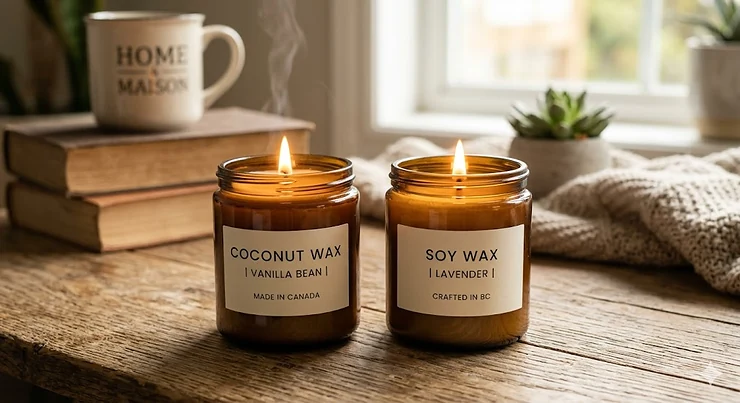
Coconut wax is pressed from coconut meat, burns cleanly with a soft, even melt pool, and carries scent exceptionally well — but it’s pricier and less available on its own. Soy wax, made from soybean oil, is cheaper, widely stocked across Canada, and burns reliably, though its scent throw is usually milder. Most “premium” candles today blend the two to balance cost and performance.

Quick Comparison Table
| Feature | Coconut Wax | Soy Wax | Coconut-Soy Blend |
|---|---|---|---|
| Melting point | Low (~24°C) | Medium (~50°C) | Medium |
| Scent throw | Excellent | Moderate | Strong |
| Burn time (per 230g) | 40–55 hrs | 45–60 hrs | 45–55 hrs |
| Soot/clean burn | Very clean | Clean | Clean |
| Price (CAD) | $25–$50 | $15–$35 | $18–$45 |
| Best for | Aromatherapy, gift candles | Everyday/budget candles | All-round home use |
Coconut wax wins on scent and clean burn but costs more and softens easily in a warm car or sunny windowsill — a real consideration during Canadian summers when shipping boxes can sit on a porch. Soy wax is the practical default for everyday use, while coconut-soy blends are why most “luxury” candle brands have moved away from pure soy: you get soy’s affordability with coconut’s stronger scent throw. For Canadian homes running forced-air heating all winter (which dries the air and can mute scent), the blend option generally performs best.
💬 Just one click — help others make better buying decisions too! 😊
✨ Don’t Miss These Deals!
🥥 Browse current coconut and soy wax candle listings on Amazon.ca to compare scents, sizes, and seller availability before you buy.
Top Picks: Coconut, Soy, and Blend Candles Worth Considering
1. Anecdote Candles (Coconut-Soy Blend)
A Canadian-friendly, woman-founded line built around coconut-soy wax and conversation-piece scent names. The blend gives stronger scent throw than straight soy, which matters in larger Canadian living rooms or open-concept condos. Anecdote ships within Canada and is sometimes available through third-party Amazon.ca sellers, though stock varies — check current listings before assuming a specific scent is in stock.
- ✅ Strong scent throw for the price
- ✅ Reusable glass vessels
- ✅ Fun, giftable branding
- ❌ Selection on Amazon.ca can be inconsistent
- ❌ Niche scents sell out fast
- Price: roughly $20–$35 CAD depending on size.

2. Paddywax Apothecary & Vista Collections (Soy Wax)
Paddywax is one of the most consistently stocked soy candle brands on Amazon.ca, with reusable jars and stated burn times in the 54–84 hour range depending on the line. For Canadian apartments with smaller rooms, the single-wick Apothecary size is plenty; larger open spaces benefit from the two-wick Vista line.
- ✅ Reliable Amazon.ca availability
- ✅ Reusable, decor-friendly jars
- ✅ Clear burn-time labelling
- ❌ Scent throw is softer than coconut
- blends
- ❌ Premium price for “basic” soy wax
- Price: roughly $25–$45 CAD.
3. Cocowix Candles Canada (100% Coconut Wax)
A Canadian-made line built specifically on cold-pressed coconut wax, marketed around lower soot and aromatherapy use. As a smaller Canadian brand, it’s primarily sold direct through its own site rather than Amazon.ca — worth noting if you specifically want the convenience of one-click Prime ordering.
- ✅ Genuinely low soot for sensitive households
- ✅ Strong cold-throw (scent even when unlit)
- ❌ Not reliably stocked on Amazon.ca — check the brand’s own site
- ❌ Higher price point than mass-market soy
- Price: roughly $25–$40 CAD.
4. Coconut Candle Company (BC, Coconut Wax + Cedar Wicks)
Hand-poured in New Westminster, BC, using coconut wax and crackling cedar wicks rather than cotton — a nice option for buyers who want the visual/audio “fireplace” element. Like Cocowix, it’s a direct-to-consumer Canadian brand, so don’t expect it on Amazon.ca; order from their site if you want guaranteed authenticity.
- ✅ Distinct crackling-wick experience
- ✅ Locally made in Canada
- ❌ Not on Amazon.ca
- ❌ Smaller scent range than national brands
- Price: roughly $20–$35 CAD.
5. Voluspa (Soy Wax, Premium Tier)
Voluspa sits at the upper end of mainstream soy candles, with elaborate jars and stronger fragrance oils than typical drugstore soy candles. It’s widely available and a common gift pick in Canada. The trade-off is that you’re partly paying for packaging, not just wax performance.
- ✅ Long, even burn
- ✅ Premium gifting presentation
- ❌ Noticeably pricier per hour of burn than basic soy
- ❌ Heavier glass jars cost more to ship to remote areas
- Price: roughly $40–$70 CAD.

6. Boy Smells (Coconut-Soy Wax Blend)
A coconut-soy blend brand known for unisex, layered scents, sold through major retailers and sometimes via Amazon listings. The blend gives it more scent throw than a plain soy candle in the same price tier.
- ✅ Distinctive, complex scents
- ✅ Coconut-soy blend balances cost and throw
- ❌ Limited availability through Canadian retailers compared to the US
- ❌ Higher cost per candle than basic soy
- Price: roughly $45–$65 CAD.
7. Rama Candles Wax Supplies (Golden Wax 454 Coconut-Soy Blend, for DIY)
If you’re candle-making rather than candle-buying, Rama Candles is a Canadian wholesale supplier carrying Golden Wax 454 — an AAK coconut-soy blend favoured for good glass adhesion and minimal frosting — alongside straight soy and coconut-apricot blends. Useful if you want to compare wax types yourself before committing to a finished retail candle.
- ✅ Canadian supplier, no cross-border shipping
- ✅ Lets you test coconut vs soy vs blend firsthand
- ❌ Requires equipment and a learning curve
- ❌ Bulk format isn’t useful if you just want one candle
- Price: roughly $15–$40 CAD depending on quantity.
How to Choose Between Coconut Wax and Soy Wax (Step-by-Step)
- Decide your budget tier. Soy wax candles in Canada typically start around $15 CAD; pure coconut wax rarely dips below $20–25 CAD.
- Think about room size. Large or open-concept rooms benefit from coconut or coconut-soy blends for stronger scent throw; small rooms do fine with soy.
- Check sensitivity to soot/smoke. Coconut wax burns cleanest; choose it if anyone in the home has respiratory sensitivities.
- Factor in your home’s climate control. Dry, heated Canadian winters mute scent faster — blends and coconut wax hold scent longer than plain soy in these conditions.
- Confirm Amazon.ca availability before ordering. Several genuinely good Canadian coconut-wax brands sell mainly through their own websites, not Amazon.ca.
- Check the wick and labelling. Under Canada’s Candles Regulations, lead-core wicks are restricted and bilingual fire-safety warnings are required — legitimate Canadian-sold candles should carry these.

Real-World Performance in Canadian Winters
Forced-air heating dries indoor air across most of Canada from November through March, and dry air carries scent less effectively than humid air. This is where coconut and coconut-soy blends earn their higher price: their lower melting point creates a fuller melt pool faster, releasing more fragrance per hour than firmer soy wax. The trade-off appears in summer instead — coconut wax candles left in a hot car, sunroom, or shipping box on a porch can develop a soft or mottled top, which is a cosmetic issue rather than a safety one, but worth knowing before you order online during a heat wave.
Common Mistakes When Buying Candles in Canada
- Assuming “natural wax” means “no fragrance additives.” Most coconut and soy candles still use synthetic or fragrance-oil blends; check the label if you want phthalate-free specifically.
- Ignoring the wick material. Canada’s Candles Regulations under the Canada Consumer Product Safety Act restrict lead in wicks — a legitimate retailer selling into Canada should comply, but imported candles bought directly from overseas marketplaces carry more risk.
- Skipping the burn-time math. A $45 candle that burns 80 hours can be cheaper per hour than a $20 candle that burns 25 hours.
- Not checking for bilingual warning labels. Health Canada has previously flagged candle products sold through online marketplaces for safety violations — a quick label check is a reasonable habit before lighting anything new.
- Buying based on jar design alone. Premium-looking packaging doesn’t guarantee better wax performance; compare wax type and burn time, not just aesthetics.
FAQ
❓ Is coconut wax better than soy wax for candles?
❓ Do soy and coconut wax candles ship reliably across Canada in winter?
❓ Are coconut wax candles worth the extra cost?
❓ Can I find pure coconut wax candles on Amazon.ca?
❓ What candle safety rules apply specifically in Canada?
Conclusion
For most Canadian households, the honest answer isn’t “coconut or soy” — it’s matching the wax to the room and the season. Soy wax remains the sensible everyday choice; coconut wax and coconut-soy blends earn their premium in larger rooms, dry winter air, or when scent throw is the priority. Whichever you choose, a quick check of the wick material and bilingual safety label takes ten seconds and is worth doing before you light anything new.
Recommended for You
- Soy vs Beeswax Candles: 7 Top Picks for Canadian Homes (2026)
- 7 Best Welcoming Candles for Entryway in Canada (2026)
- 7 Best Peppermint Office Candles Canada 2026 — Boost Focus Fast
Disclaimer: This article may contain affiliate links. As an Amazon Associate, this site may earn from qualifying purchases. If you purchase products through these links, the site may earn a small commission at no additional cost to you. Affiliate relationships are disclosed in line with Ad Standards Canada’s Influencer Marketing Disclosure Guidelines.
Found this helpful? Share it with a friend who’s still burning paraffin. 💬🤗
