
In This Article
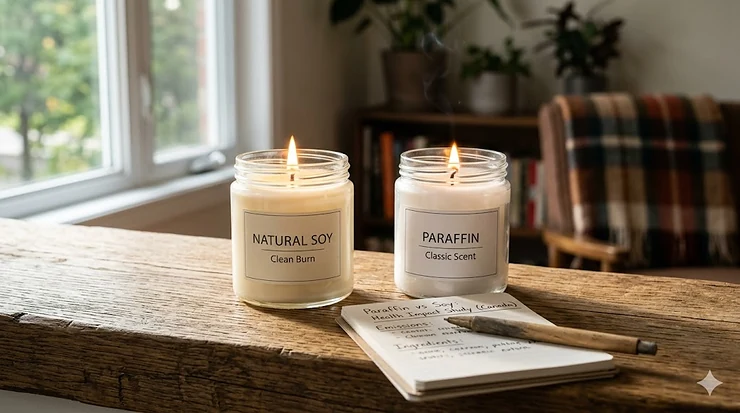
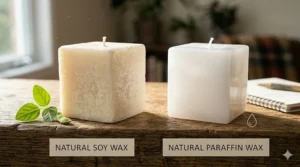
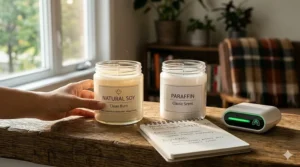
Paraffin wax is a petroleum by-product, while soy wax comes from soybean oil — and that difference matters once you light a wick. The paraffin vs soy candles health debate centres on volatile organic compounds (VOCs) and soot: most research finds paraffin candles release more soot and a few more VOCs than soy, but for typical occasional use in a ventilated room, both fall well under Health Canada’s indoor air thresholds.
If you’ve spent any time scrolling candle reviews on Amazon.ca, you’ve probably noticed the same question pop up over and over: is a paraffin candle actually going to hurt you, or is “soy” just a marketing word stuck on a label to charge more? It’s a fair question, especially for anyone in Canada who’s burning candles for six dark months of the year with the windows shut against the cold.
The honest answer is more nuanced than either “paraffin is toxic” or “soy is perfectly safe.” Both claims show up constantly in marketing copy, and both oversimplify a topic that scientists themselves don’t fully agree on. So let’s actually walk through what the research says, what Health Canada has published on candle safety, and which candles — across paraffin, soy, and beeswax — make sense for a Canadian home in 2026.
Quick Comparison: Paraffin vs Soy vs Beeswax at a Glance
| Wax Type | Source | Soot Output | Typical VOC Output | Burn Time | Best For |
|---|---|---|---|---|---|
| Paraffin | Petroleum | Higher, especially with untrimmed wicks | Slightly higher (benzene, toluene traces) | Shorter | Budget buyers, strong scent throw |
| Soy | Soybean oil | Lower | Lower, but rises with heavy synthetic fragrance | Longer | Most households wanting a cleaner burn |
| Beeswax | Bee-derived | Lowest | Lowest, often unscented | Longest | Asthma/allergy-prone households |
| Soy-paraffin blend | Mixed | Moderate | Moderate | Moderate | Strong scent + decent burn cleanliness |
Looking at the table, the gap between soy and beeswax is smaller than marketing usually suggests, while the real outlier is paraffin — particularly cheap, heavily fragranced paraffin with an oversized wick. The catch, and it’s a big one for Ontario and Quebec shoppers stocking up for winter, is that a “soy blend” candle with a harsh synthetic fragrance can sometimes emit more VOCs than a well-made, lightly scented paraffin candle. Wax type sets the baseline; fragrance load and wick quality do a lot of the actual damage.
💬 Just one click — help others make better buying decisions too! 😊
✨ Don’t Miss These Exclusive Deals!
🔍 Take your home fragrance routine to the next level with these carefully selected picks. Click on any highlighted product to check current pricing and availability on Amazon.ca. These candles will help you create a cozier, cleaner-smelling home your family will actually notice. 🇨🇦
7 Candles Canadians Reach for When Choosing a Cleaner Burn
A quick note before this list: exact Amazon.ca pricing shifts constantly, so every figure below is a typical CAD range based on standard retail pricing, not a live quote. Always confirm current price and shipping eligibility on the product page before buying.
1. Mrs. Meyer’s Clean Day Soy Candle
Mrs. Meyer’s built its whole brand on plant-derived ingredients, and the candle line follows the same formula as its cleaning products — a soy wax base scented with essential oil blends like lavender, basil, or geranium. What this means in practice: lighter scent throw than a heavily synthetic paraffin candle, but noticeably less greasy soot buildup on jar glass over time, which matters if you’re burning candles daily through a Canadian winter in a closed-up apartment. Buyers generally describe the scent as “fresh” rather than overpowering, which suits smaller condos and rentals where strong fragrance lingers.
✅ Soy wax,
✅ widely stocked,
✅ good for scent-sensitive households.
❌ Throw is weaker in larger living rooms,
❌ limited scent range compared to dedicated candle brands.
Price range: around $18–$26 CAD. Solid value if low-fragrance, plant-based is your priority.
2. WoodWick Trilogy Candle by Yankee Candle
WoodWick’s whole appeal is the wooden wick that crackles like a tiny fireplace — genuinely satisfying on a snowy evening. The wax is typically a soy-paraffin blend rather than 100% soy, which is worth knowing if “paraffin-free” is your hard requirement. The wood wick burns slightly hotter and wider than cotton, so trimming it correctly matters more here than on most candles to avoid extra soot. This is the pick for people who want ambiance over purity — the crackle effect alone is why most buyers repurchase.
✅ Distinctive crackling sound,
✅ strong scent throw,
✅ widely available.
❌ Not 100% soy,
❌ wood wick needs regular trimming to stay clean-burning.
Price range: around $25–$34 CAD.
3. Chesapeake Bay Candle Heritage Collection
Chesapeake Bay positions itself as an accessible soy-blend option, usually landing in the mid-range price tier with relatively conservative, “safe” scent profiles — vanilla, driftwood, white tea. The eco-conscious packaging and reusable glass jars are a genuine plus if you’re trying to cut down on landfill waste, a detail more Canadian shoppers are factoring into purchases. Reported sentiment skews toward “reliable but unexciting” — exactly what you want from an everyday candle rather than a statement piece.
✅ Reusable jar,
✅ consistent scent profile,
✅ mid-range pricing.
❌ Scent throw is moderate at best,
❌ fewer bold/unusual fragrances.
Price range: around $20–$28 CAD.
4. Paddywax Eco Candle
Paddywax leans into a coconut-soy wax blend, which burns slightly cleaner than pure soy in independent burn tests because coconut wax has an even lower melting point and produces minimal soot. The brand’s glass vessels are designed to be repurposed as drinking glasses or planters afterward — a small but real waste-reduction detail for apartment dwellers without much storage. This is a strong pick if you specifically want to avoid paraffin entirely while still getting reasonable scent strength.
✅ Coconut-soy blend,
✅ reusable glass,
✅ paraffin-free.
❌ Premium price point,
❌ scent selection is smaller than mass-market brands.
Price range: around $30–$42 CAD. Worth the premium if “paraffin-free” is non-negotiable for you.
5. P.F. Candle Co. Classic Line
P.F. Candle Co. uses 100% soy wax with a cotton wick — no wood, no blend, no ambiguity on the label. The scent profiles (think “Teakwood,” “Golden Hour”) lean earthy and gender-neutral rather than sweet, which has made the brand a favourite among younger Canadian renters decorating smaller spaces. Because it’s pure soy with a simple cotton wick, soot deposits on jars and walls are minimal even with regular use — genuinely one of the cleanest mass-available options in this list.
✅ True 100% soy,
✅ minimal soot,
✅ distinctive scent identity.
❌ Smaller jar sizes for the price,
❌ scent throw is gentle, not room-filling.
Price range: around $28–$36 CAD.
6. Big Dipper Wax Works Pure Beeswax Candle
If “non-toxic candle alternatives” is what actually brought you to this article, beeswax is the category to look at, and Big Dipper is one of the more established pure-beeswax brands available through Amazon. These candles are typically unscented or only very lightly honey-scented, since beeswax doesn’t hold synthetic fragrance oils the way soy and paraffin do — which is precisely why allergy and asthma-prone households gravitate toward them. The trade-off is cost: beeswax is more expensive to produce than soy or paraffin, so you’re paying a premium for the cleanest burn on this list.
✅ Lowest soot/VOC profile,
✅ great for allergy-prone households,
✅ naturally non-toxic.
❌ Higher price per candle,
❌ minimal fragrance options.
Price range: around $24–$38 CAD. The clear winner if breathing comfort outranks scent variety.
7. Budget Mass-Market Paraffin Candles
Worth including for contrast: the unbranded paraffin pillar and jar candles found in supermarket and dollar-store aisles across Canada. These are almost always 100% paraffin with synthetic dyes and fragrance oils, and they’re the products most often referenced in the soot studies cited below. They’re genuinely fine for occasional, well-ventilated use — the actual research doesn’t support throwing every paraffin candle in your house away — but they’re also the category where overwicking, heavy dye, and cheap fragrance oil combine to produce the most visible soot.
✅ Very low cost,
✅ widely available everywhere,
✅ strong scent throw.
❌ Most soot-prone option here,
❌ wick quality is inconsistent.
Price range: typically under $10–$15 CAD. Fine for occasional use; not the pick for daily burning in a small, closed room.
How Paraffin and Soy Candles Actually Differ: What the Research Shows
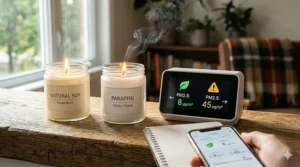
Here’s where the marketing and the science genuinely diverge. Industry-funded laboratory testing comparing paraffin, soy, stearin, and beeswax found their total VOC emissions were comparable, ranging from roughly 3 to 5 micrograms per gram of wax burned — a result candle manufacturers point to as evidence that wax type barely matters. Independent health researchers tell a less tidy story: a University of South Florida soot test, along with older Journal of the Air & Waste Management Association research, found paraffin candles produced meaningfully more soot than soy or beeswax, especially with untrimmed wicks, and that soot can carry pollutants deep into the lungs.
Where most outlets agree is that synthetic fragrance, not wax type alone, is the bigger driver of indoor pollutants. Some studies on scented candles have found unexpectedly high formaldehyde concentrations from heavily fragranced candles, while other research concludes wax type is the dominant variable. Even Health Canada’s own position is more reassuring than either marketing camp suggests: in its 2021 indoor air quality research across Edmonton, Regina, Halifax, and Montreal homes, no meaningful association was found between candle use and indoor benzene concentrations.
A CNN health piece summarized the expert consensus well: paraffin wax does release VOCs, and it’s generally considered more polluting than soy, beeswax, or stearin candles, but the science on whether any of this meaningfully harms health is genuinely mixed rather than settled. Translation for your living room: switching from paraffin to soy is a reasonable, low-cost precaution, not a medical necessity.
What to Expect: Real-World Performance in a Canadian Home
Lab results are one thing; a closed-up condo in a Winnipeg January is another. Canadians burn candles more, and for longer, during the cold months simply because windows stay shut and people spend more waking hours indoors. That changes the calculation slightly compared to milder climates: poor ventilation is the single biggest amplifier of any candle’s emissions, regardless of wax type.
In practice, this means a soy candle burned for two hours with a cracked window does less to your indoor air than a beeswax candle burned for six hours in a sealed, 250-square-foot bedroom. Wax type sets a baseline risk; your ventilation habits multiply or shrink it. If you’re someone who lights a candle and then closes the bedroom door for the night, the wax type genuinely matters less than simply not doing that.

A Practical Usage Guide for Burning Candles Safely This Winter
Most of the soot and VOC concerns above are made worse, or better, by a handful of habits that have nothing to do with which wax you bought:
- Trim the wick to about 6 mm before every burn — an overly long wick is the single biggest cause of black soot, regardless of wax type.
- Don’t burn any candle for more than about four hours at a stretch; the wax pool overheats and emissions rise.
- Keep a window cracked or a small fan circulating air in the room, especially in smaller Canadian apartments with limited airflow.
- Store unused candles away from direct sunlight and heat in winter — basements and unheated porches can cause soy wax to sweat or discolour.
- If a candle is producing visible smoke or your eyes start to sting, put it out. That’s your body telling you ventilation or wick length needs fixing.
A Buyer’s Decision Framework for Canadian Shoppers
- If you have asthma, allergies, or live with young children → choose a beeswax or 100% soy candle with no synthetic fragrance, and keep burns short.
- If you want strong scent throw and don’t mind some trade-off → a soy-paraffin blend like WoodWick gives you ambiance without going full paraffin.
- If budget is the deciding factor and you burn occasionally with good ventilation → mass-market paraffin candles are not the health risk marketing implies, as long as you trim wicks and ventilate.
- If “paraffin-free” is a hard requirement → look specifically for labels stating 100% soy or 100% coconut-soy, since “soy blend” can legally mean a small soy percentage mixed with paraffin.
Common Mistakes When Buying “Non-Toxic” Candles in Canada
The biggest mistake is trusting the word “natural” on a label — it isn’t a regulated term in Canada or anywhere else, and a candle can call itself natural while containing mostly paraffin. The second is assuming “soy” means 100% soy; many commercial soy candles are blends, and the percentage usually isn’t disclosed unless you dig into the brand’s own site. The third, and most overlooked, is ignoring the wick entirely while obsessing over wax type — an oversized or poorly centred wick on a premium soy candle can produce more soot than a well-made paraffin one. Finally, Canadians sometimes assume any candle sold on Amazon.ca has been vetted for safety; it hasn’t, and lead-wick imports, while rare since the 2003 ban, do occasionally slip through on resold or grey-market listings.
✨ Don’t Miss These Exclusive Deals!
🔍 Browse the cleaner-burning options above directly on Amazon.ca — checking current price and Prime eligibility takes about ten seconds and could change which one makes sense for your budget. 🇨🇦
Canadian Regulations and Safety Standards You Should Know
Lead-core wicks have been illegal in Canada since 2003, but Health Canada still recommends checking older or imported candles by exposing the wick tip and rubbing it on white paper — a grey mark suggests a metallic, potentially lead, core. Health Canada also specifically warns against “relight” or trick candles and liquid paraffin oil lamps, the latter having caused poisoning incidents in children who drank the fuel directly. There’s no federal labelling requirement forcing brands to disclose exact wax percentages in a “soy blend,” which is part of why blended candles can market themselves as “soy” with relatively little soy content. On the fire-safety side, Canadian data from Ontario, Manitoba, Alberta, and B.C. estimates candles cause hundreds of residential fires across Canada annually, mostly from candles left unattended near flammable material rather than from the wax itself.
Long-Term Cost and Value in CAD
Beeswax and premium soy-coconut blends cost more per candle but generally burn 25–50% longer than paraffin of the same size, since paraffin tends to burn hotter and faster. Over a winter season of regular use, a $35 CAD beeswax candle that lasts 60 hours often works out cheaper per hour than a $12 CAD paraffin candle that burns out in 25. Budget paraffin candles still make sense for occasional use — holiday dinners, guest rooms, short evenings — where the lower upfront cost outweighs the shorter burn time.
FAQ
❓ Are soy candles actually better for indoor air quality than paraffin?
❓ Do paraffin candles release toxic fumes in a typical Canadian living room?
❓ Is it safe to burn candles daily through a Canadian winter with windows closed?
❓ Can I find genuinely non-toxic candles on Amazon.ca?
❓ How do I check if an older candle has a lead wick, per Health Canada guidance?
Conclusion
The paraffin vs soy candles health debate isn’t really a contest with one clear winner — it’s a question of degree. Soy and beeswax candles generally burn a little cleaner than paraffin, and Health Canada’s own data suggests occasional candle use of any kind isn’t a major indoor air threat for most households. Where it actually matters is in the details marketing tends to skip: wick length, burn duration, fragrance load, and whether “soy blend” means 5% soy or 95%. If you’re shopping Amazon.ca this winter, a 100% soy or beeswax candle with a cotton or wood wick, burned in a ventilated room for under four hours at a time, covers nearly all of the realistic health upside — without needing to swear off candles altogether.
Recommended for You
- Coconut Wax vs Soy Wax Candles: 7 Best Picks for Canada (2026)
- Soy vs Beeswax Candles: 7 Top Picks for Canadian Homes (2026)
- 7 Best Welcoming Candles for Entryway in Canada (2026)
Disclaimer: This article contains affiliate links. As an Amazon Associate, I earn from qualifying purchases. If you purchase products through these links, we may earn a small commission at no additional cost to you.
✨ Found this helpful? Share it with your friends! 💬🤗
