
In This Article
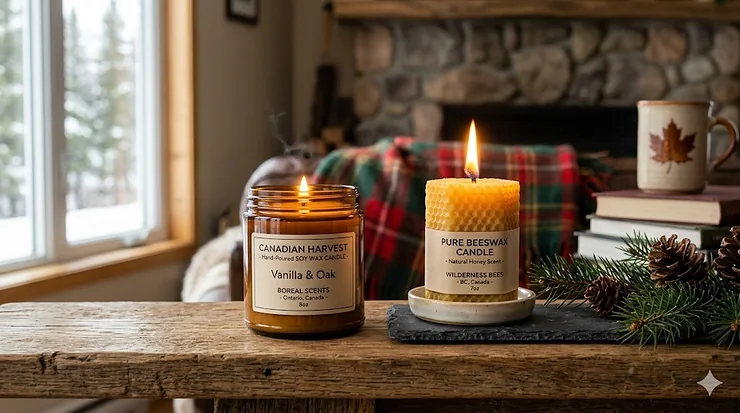
Soy vs beeswax candles is one of those debates that sounds simple until you’re standing in front of a wall of jars on Amazon.ca, trying to figure out which one will actually survive a Canadian winter without tunnelling, smoking up your kitchen, or burning out after two evenings. Both are marketed as the “clean” alternative to paraffin, and both have loyal fans. But they behave differently the moment a flame touches them, and that difference matters more once the furnace is running non-stop from November to April and your windows stay shut for months.

This guide breaks down the real differences in burn time, scent throw, cost, and indoor air impact, then walks through seven real, currently listed Amazon.ca candles — four soy, three beeswax — so you’re not guessing. We’ll also flag what Health Canada actually says about candles and indoor air, since that’s a detail most candle blogs skip entirely.
Quick Comparison Table
| Factor | Soy Wax | Beeswax |
|---|---|---|
| Melting point | ~45-65°C (lower) | ~62-64°C (higher) |
| Burn time (same size) | Shorter, burns faster | Roughly 30-50% longer |
| Scent throw | Strong, holds fragrance oils well | Mild, naturally honey-scented |
| Soot/air quality | Very low soot, clean burn | Lowest soot, often soot-free |
| Price (CAD) | Budget to mid-range | Mid-range to premium |
| Best for | Scented jar candles, gifting | Unscented ambiance, sensitive noses |
The price gap is the first thing most Canadian shoppers notice — beeswax usually costs more per hour of burn because the raw material is limited by how much wax bees actually produce, while soy is a high-volume agricultural by-product. That said, because beeswax burns slower, the cost-per-hour gap narrows once you account for the longer burn time. If scent is your priority, soy wins outright, since beeswax barely holds added fragrance oils and most pure beeswax candles are left unscented on purpose.
💬 Just one click — help others make better buying decisions too! 😊
✨ Don’t Miss These Exclusive Deals!
🔍 Take your candle shopping to the next level with these carefully selected picks below. Click any highlighted product to check current pricing and availability on Amazon.ca. 🇨🇦
Top 7 Soy & Beeswax Candles — Expert Analysis
1. World’s Best Soy Candle (Handmade in Canada, 8 oz)
Handpoured in a Toronto studio, this is one of the few soy candles on Amazon.ca that’s genuinely made domestically rather than imported and relabelled. The 8 oz size is on the smaller end, which matters in practice — Canadian reviewers note it runs through faster than expected for the price, so treat it as an occasional-use accent candle rather than an all-evening living-room candle. What stands out is scent consistency: lighter florals and laundry-style scents come through clean without the “perfume overload” some imported soy candles have.
✅ Made in Canada, small-business brand, clean scent profile
❌ Small jar for the price, burn time shorter than bigger competitors Price: roughly $18-$24 CAD.
Verdict: good for gifting or testing a scent before committing to a bigger jar.
2. M&SENSE Natural Soy Candle (Teakwood / Fresh Linen, ~9-10 oz)
M&SENSE shows up across Amazon.ca’s soy candle listings with a wooden wick option, which crackles softly while burning — a small detail that makes a difference during dark Canadian evenings when you want ambiance, not just scent. The 50+ hour burn time on the larger sizes holds up reasonably well against reviewer reports, though cold rooms (think an unheated sunroom or garage in January) can slow the melt pool and cause uneven burning if you don’t trim the wick.
✅ Wood wick crackle, long burn time, widely stocked
❌ Scent throw is moderate rather than room-filling, some batch inconsistency reported Price: roughly $20-$28 CAD.
Verdict: solid mid-range pick for year-round use.
3. Yankee Candle Large Jar (Plant Wax Blend, 22 oz, e.g. Balsam Cedar)
Yankee Candle’s large jars use a plant-wax blend rather than 100% soy, but they’re worth including because they’re genuinely available and well-stocked on Amazon.ca, with a 150-hour burn time that’s hard to beat at this price tier. For Canadians who want a “set it and forget it” candle through the holiday season, the room-filling scent throw (Balsam Cedar especially) does real work in larger open-concept living rooms. The trade-off is that a wax blend isn’t the cleanest-burning option on this list — if 100% natural wax is your priority, skip to the soy or beeswax picks above and below.
✅ Huge burn time, strong scent throw, easy to find
❌ Not pure soy wax, blend composition varies by scent Price: roughly $30-$38 CAD.
Verdict: best for big rooms and long burns, not for purists.
4. AOOVOO Soy Candle (Coconut Vanilla or Sage, 9-12 oz)
AOOVOO’s candles lean into gifting — sage-and-crystal sets, coconut-vanilla jars — and they’re consistently in stock on Amazon.ca with Prime shipping. The soy wax base burns cleanly, and the lower melting point means they release fragrance quickly once lit, which is handy in smaller condo units common in cities like Toronto or Vancouver where you want fast scent payoff in a compact space. Burn evenly only if you let the first burn go long enough to form a full melt pool edge-to-edge; cutting it short early creates the tunnelling soy candles are notorious for.
✅ Fast scent throw, attractive gift packaging, budget-friendly
❌ Needs a full first burn to avoid tunnelling, scent fades faster in larger rooms Price: roughly $15-$22 CAD.
Verdict: good budget gift candle for apartment-sized spaces.
5. Dutchman’s Gold Beeswax Votive Candles (100% Pure Canadian Beeswax, 3-pack)
Dutchman’s Gold is a real Canadian apiary brand, and their votives are 100% Canadian beeswax rather than an imported blend — worth checking the label for, since the Canadian beeswax market does see imported substitutes mixed with paraffin. Votives like these are a smart way to try pure beeswax without committing to an expensive pillar: they’re naturally dripless, carry a faint honey scent rather than added fragrance, and burn with minimal soot, which is genuinely noticeable if you’ve ever wiped soot residue off a windowsill after a winter of paraffin candles.
✅ Verified Canadian beeswax, clean burn, no synthetic fragrance
❌ Unscented (a pro or con depending on preference), votive holder sold separately Price: roughly $14-$20 CAD for a 3-pack.
Verdict: the most trustworthy “pure beeswax” entry point on this list.

6. Natural Beeswax Pillar Candles (4-pack, 2×4 inch, ~140-hour combined burn)
These pillar sets show up reliably in Amazon.ca’s beeswax category and offer a practical way to test beeswax’s longer burn time directly against a soy candle of similar size. Because beeswax has a notably higher melting point, these pillars hold their shape well even in a slightly warm room — useful in Canadian homes where forced-air heating can leave living rooms warmer than expected in deep winter. Expect a subtle golden-yellow flame that’s brighter than a soy candle’s flame, a small but real visual difference once you’ve seen both side by side.
✅ Long combined burn time, holds shape in warm rooms, dripless
❌ Generic packaging with limited country-of-origin detail — worth double-checking the listing for sourcing Price: roughly $20-$28 CAD for the set.
Verdict: best value entry into pillar-style beeswax.
7. 100% Pure Beeswax Taper Candles (Handmade in Canada, 10-piece set)
This taper set stands out because the listing explicitly states Canadian handmade production, which matters given how much of the beeswax sold on Amazon.ca is imported and only blended with a small percentage of real beeswax. Tapers burn faster per candle than pillars but are ideal for dinner tables, holiday centrepieces, or anywhere you want classic warm light rather than a scented room-filler. Because they’re unscented, they’re a safer pick for anyone managing fragrance sensitivities at the table, a detail that matters more during family gatherings than most candle listings acknowledge.
✅ Confirmed Canadian handmade, fragrance-free (good for sensitivities), classic look
❌ Tapers burn relatively quickly per stick, needs a proper taper holder Price: roughly $18-$25 CAD for 10.
Verdict: the pick for dinner tables and holiday décor over daily room-scenting.
Real-World Scenarios: Which Candle Fits Your Home
The Toronto condo dweller. Limited square footage, no fireplace, and a need for fast scent payoff in a small living-dining combo. An AOOVOO or M&SENSE soy jar makes more sense than beeswax here — the lower melting point means scent fills the room within 20-30 minutes, which matters when you’re hosting in 500 square feet.
The Ottawa or Calgary family with kids. Long winters mean candles burn most evenings from October through March. A Dutchman’s Gold votive or beeswax pillar set is the safer long-term choice — minimal soot means less residue near kids’ play areas, and the absence of synthetic fragrance reduces the chance of triggering sensitivities in a household with multiple people.
The Vancouver or Halifax gift-giver. Coastal humidity can soften soy wax faster in storage, so a beeswax taper set or the Made-in-Canada soy candle (smaller, used quickly) both avoid the “melted in transit” problem that bigger soy jars sometimes report in warmer, damper regions.
Problem → Solution Guide
Problem: My soy candle tunnels down the middle and won’t burn evenly. Solution: Let the first burn run until the entire top surface is liquid wax, edge to edge — usually 2-3 hours for a standard jar. Skipping this step is the single biggest cause of tunnelling.
Problem: My beeswax candle barely has any scent. Solution: That’s expected — beeswax holds fragrance oils poorly compared to soy. If scent matters most, choose soy; if ambiance and clean air matter most, treat beeswax’s faint honey note as a feature, not a flaw.
Problem: My candle arrived with a foreign-language-only label. Solution: Bilingual labelling (English and French) is legally required for products sold in Canada. A foreign-language-only label is a sign the seller may be shipping non-compliant imports — check the Amazon.ca listing’s country of origin before buying, and favour sellers who clearly state “Made in Canada” or “Sold by” a Canadian business.
Problem: I’m not sure if a “soy” candle is actually 100% soy. Solution: Many commercial “soy” candles are soy-paraffin blends. Check the product description for “100% soy wax” specifically — if it only says “soy wax blend” or “plant-based wax,” assume some paraffin content.
How to Choose Between Soy and Beeswax in Canada
- Decide if scent matters more than air purity. Soy holds fragrance oils far better; beeswax is nearly scent-neutral.
- Check your room size. Beeswax’s higher melting point performs better in warmer rooms; soy’s lower melting point throws scent faster in smaller spaces.
- Factor in your heating season. If you’re burning candles five months a year, beeswax’s longer burn time per dollar starts to look more competitive despite the higher upfront price.
- Look for “Made in Canada” or named Canadian apiaries/brands (Dutchman’s Gold, for example) to avoid diluted imported beeswax.
- Check for bilingual labelling. Its absence is a red flag for compliance, not just a minor inconvenience.
- Match the format to the use case. Tapers and pillars for décor and dinner tables; jars for everyday room-scenting; votives and tealights for testing a wax type cheaply before committing.

Soy vs Beeswax: Burning Properties Compared
The melting-point gap is the root cause of almost every other difference between these two waxes. Soy wax typically softens around 45-65°C, while beeswax holds its shape until roughly 62-64°C. That’s why beeswax candles burn an estimated 30-50% longer than a soy candle of the same size — the wax simply resists melting longer once lit.
That same property cuts the other way for scent. Because soy liquefies at a lower temperature, it forms a wider melt pool faster, which pushes fragrance oils into the air more aggressively — useful for scent throw, less useful if you wanted a candle that lasts through an entire Canadian winter on one jar.
On air quality, both waxes are considered clean-burning relative to paraffin, producing minimal visible soot. Beeswax has a slight edge here and a reputation for releasing negative ions that some sources claim help bind airborne dust and allergens, though this effect isn’t well documented in peer-reviewed literature and shouldn’t be treated as a proven air-purifying claim. The more reliably documented point, per Health Canada, is broader: candles and incense are listed among indoor combustion sources that increase particle levels indoors, regardless of wax type, so ventilation matters more than which wax you choose.
Canadian Regulations & Safety Standards
Candles sold in Canada fall under the Canada Consumer Product Safety Act, which restricts lead content in metal-cored wicks and requires manufacturers to address fire-safety risks like spontaneous reignition after the flame is extinguished. Most quality soy and beeswax candles use cotton or wood wicks rather than metal-cored ones, which sidesteps the lead concern entirely — but it’s worth checking the listing if a candle ships from outside Canada, since enforcement on third-party imported listings is inconsistent.
Federally, Health Canada lists candles and incense among common indoor combustion sources that can raise indoor VOC and particle levels, alongside cooking and off-gassing furniture — a useful reminder that “natural wax” doesn’t mean “zero impact,” it just means a lower impact than paraffin. Bilingual labelling under Canadian consumer packaging law is the other compliance point worth checking, particularly for smaller imported sellers on Amazon.ca who sometimes skip it.
Long-Term Cost in CAD
A beeswax candle’s higher sticker price is partly offset by its longer burn time. A $20 CAD beeswax pillar burning roughly 140 hours works out to about $0.14 CAD per hour. A comparably priced $20 CAD soy jar burning closer to 50-60 hours lands around $0.33-$0.40 CAD per hour. Soy still wins on upfront cost and scent value for casual use, but for households burning candles nightly through a long Canadian winter, beeswax’s cost-per-hour can end up more competitive than the shelf price suggests.
Frequently Asked Questions
❓ Is soy or beeswax better for allergies in Canada?
❓ Do beeswax candles really purify the air?
❓ Can I get 100% pure beeswax candles shipped across Canada, including remote areas?
❓ Why does my soy candle smell weaker after a few burns?
❓ Are soy candles safe for pets?
Conclusion
Neither wax is objectively “better” — soy wins on scent and price, beeswax wins on burn time and clean air. For Canadian households running candles through long heating seasons, that trade-off is worth thinking through before buying, not after. If you want strong scent in a smaller space, an AOOVOO or M&SENSE soy jar is the practical pick. If you want a cleaner-burning candle that lasts through a long winter evening, Dutchman’s Gold’s verified Canadian beeswax votives are the safer bet — just don’t expect much fragrance from them.
Whichever you choose, check the listing for “Made in Canada” or a named Canadian brand, confirm bilingual labelling, and let that first burn run long enough to avoid tunnelling. Those three habits solve most of the complaints in candle reviews.
Recommended for You
- 7 Best Welcoming Candles for Entryway in Canada (2026)
- 7 Best Peppermint Office Candles Canada 2026 — Boost Focus Fast
- 7 Best Candles for Concentration in Canada 2026 – Boost Focus Now
Disclaimer: This article contains affiliate links. As an Amazon Associate, I earn from qualifying purchases. If you purchase products through these links, we may earn a small commission at no additional cost to you.
✨ Found this helpful? Share it with your friends! 💬🤗
