
In This Article
A plug-in diffuser vs USB diffuser comparison comes down to one question: where does the power come from? Plug-in models draw from a wall outlet and stay put. USB models run from a laptop, power bank or phone-style adapter and travel easily. Run time, room coverage and even how often you refill all follow from that one choice.

It sounds like a tiny technical detail. It isn’t. Pick the wrong power source and you’ll end up with a diffuser that’s gorgeous on the shelf and useless where you actually spend your day. Think of the outlet behind your sofa. Think of the desk where your laptop port is already doing three jobs.
The electronics are simpler than they look. A standard USB port supplies 5 volts, and a basic USB 2.0 port is specified for up to 500 mA, or about 2.5 W. That’s plenty for a small ultrasonic disc but not much else. Wall-powered units can be larger, quieter and smarter. They can also be stubbornly tied to one spot.
Below you’ll find seven real, researched picks across budget, mid-range and premium, a spec-by-spec interpretation, and practical guidance built around Canadian homes: dry winter air, condo outlets and all. Prices are ranges in CAD, so check current prices before you buy.
Quick Comparison Table: Plug-in Diffuser vs USB Diffuser Comparison at a Glance
| Pick | Power Source | Cordless? | Best For |
|---|---|---|---|
| Pura 4 | Wall plug-in (outlet) | No | Hallways and medium rooms, set-and-forget scenting |
| Pura Mini | Wall plug-in (outlet) | No | Small bedrooms and bathrooms |
| Pura Plus | Wall power, freestanding | No | Open-concept and high-ceiling spaces |
| Vitruvi Stone | Cable + adapter (USB-C to USB-A cable) | No | Bedside tables and shelves with an outlet nearby |
| NOW 7523 | USB (laptop, power bank, adapter) | No | Desk setups and budget buyers |
| Vitruvi Move | Rechargeable battery, USB-C | Yes | Moving one diffuser room to room |
| Vitruvi Air Cordless | Rechargeable battery, USB-C | Yes | Waterless, low-maintenance portability |
Look at the pattern in the table. Anything that needs refilling with water (Vitruvi Stone, NOW 7523, Vitruvi Move) lives on a flat surface. The wall-mounted Pura 4 and Pura Mini skip the surface entirely but lock you into fragrance vials. Vitruvi Air Cordless is the odd one out: it goes cordless without water, so it’s the most flexible and also the most consumable-dependent.
Budget buyers should note that NOW 7523 is the cheapest way in. If you want to ignore your diffuser for a month, the wall plug-ins win.
💬 Just one click — help others make better buying decisions too!😊
Top 7 Diffusers in Our Plug-in Diffuser vs USB Diffuser Comparison: Expert Analysis
1. Pura 4 — discreet wall plug-in with app control
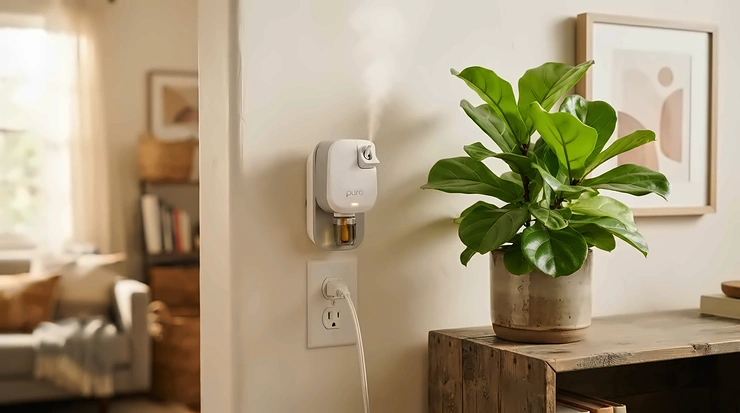
The standout is how little it asks of your room: no tank, no cord, no counter space. It sits flush on the outlet like a matte white button. It takes two fragrance vials and is controlled through the Pura app (or Alexa and Google Home), and the setup guide warns against plugging it into extension cords. All Pura units only work with 2.4 GHz Wi-Fi, which is worth knowing before a mesh network makes the setup a headache.
Two vials means you can schedule a bright citrus for mornings and something cozier for evenings without touching the unit. Pura rates a vial at about 22 days in a medium space at 6–8 hours a day on medium intensity. On paper that’s roughly one refill a month for a hallway or living room. What the spec sheet won’t tell you, but reviewers note, is that the proprietary cartridges make this a recurring cost. One roundup warned that it isn’t ideal if you want a scent running all day, every day.
This is for the person who wants the “boutique lobby” effect with zero maintenance. It’s not for anyone who dislikes app-dependent gadgets, because there are no manual controls.
Reviewers consistently praise the low-profile design and the fine control over intensity. The common caveats are cartridge cost and app dependence.
Pros:
- ✅ Sits flush on the wall, no counter space needed
- ✅ Dual vial bays allow scheduled scent swaps
- ✅ No water, no refilling, no cleaning tank
Cons:
- ❌ App-only control and 2.4 GHz Wi-Fi requirement
- ❌ Proprietary vials add an ongoing cost
Roughly C$55–C$80 range at the time of research. Good value if you’ll actually use the scheduling, mediocre if you’d rather pour in your own oils.

2. Pura Mini — compact plug-in built for tiny rooms
Its standout feature is restraint. The Pura Mini is designed for small, compact spaces. It automatically detects the vial you insert and adapts its diffusion to the room’s temperature for steadier scenting.
The spec that matters is longevity. Pura says a vial lasts about 30 days in a small space at 6–8 hours a day on medium intensity. That’s noticeably longer than the 22 days quoted for the Pura 4, because the smaller output is matched to a smaller room. In plain terms, you pay less per month in a powder room or small bedroom than you would by running a bigger unit there.
My analytical take: this is the plug-in answer to the condo bedroom. It fits where a bulky tank diffuser wouldn’t, and its modest output is a feature, not a flaw, in a 10 m² room. Don’t expect it to scent an open living area, though. It’s built for enclosed spaces, and its output will vanish in a big room.
Reviewers describe it as quiet and unobtrusive. As with the rest of the line, control runs through the app, and the vial ecosystem is the main ongoing cost. I couldn’t verify a large pool of independent owner reviews specific to this model, so treat the sentiment above as the general Pura family pattern.
Pros:
- ✅ Vial lasts about a month in small rooms
- ✅ Automatic vial detection and adaptive output
- ✅ Takes up zero surface space
Cons:
- ❌ Too small to scent open or large rooms
- ❌ App control required, no manual buttons
Roughly C$40–C$65 range. Excellent value for small spaces, poor value if you stretch it beyond its remit.
3. Pura Plus — large-room plug-in power
The standout here is reach. It’s the Pura built for high ceilings and open floor plans, a freestanding cylinder with dual vial bays that reviewers describe as the best option when the smaller plug-ins disappear into the room. Unlike the app-only Pura 4 and Pura Mini, it has manual on/off buttons on the front, a real plus when your phone is across the house.
The trade-off is audible. One tested roundup measured it at around 32 decibels, a faint whoosh comparable to a fan on low, while the smaller Puras are essentially silent. At bedtime that matters. In a kitchen-living area it will vanish into the background noise.
Pura quotes about 14 days per vial in a large or open-concept space at 6–8 hours daily on medium intensity. Run that math: roughly two vials a month in a big room. That’s the cost of being the “big gun”. If you scent a basement or great room daily, budget accordingly. Check the Amazon.ca listing for the power-cable setup, since I couldn’t confirm the exact adapter details.
Reviewers like the stronger throw and the physical controls. The recurring complaints mirror the family: pricey refills and a fan whoosh.
Pros:
- ✅ Covers large and open-concept spaces
- ✅ Manual buttons plus app control
- ✅ Dual vial bays for scheduled blends
Cons:
- ❌ Audible fan sound at about 32 dB
- ❌ Highest refill cost of the three Puras
Roughly C$100–C$140 range. Worth it only if the room genuinely needs it.
4. Vitruvi Stone — Vancouver-designed ceramic classic
The standout is that it looks like pottery, not electronics. It’s a Vancouver-designed ultrasonic diffuser with a matte ceramic cover, an optional LED, and a 70 ml reservoir. Its two timer settings are about 4 hours continuous or 8 hours intermittent, and it shuts off automatically when the water runs out.
Brand figures list coverage up to 500 square feet (about 46 m²) and a noise level around 30 decibels. Treat the coverage number as a best case in a closed room, not a promise for an open plan. Here’s the wrinkle for our plug-in diffuser vs USB diffuser comparison: some listings ship it with a USB-C to USB-A cable and no power adapter, while older versions used a wall cord. So the Vitruvi Stone is really a USB-powered device that lives near an outlet. Check which version you’re buying.
That matters for placement. You’ll plug it into a wall adapter or a laptop’s port, and the cable determines how far it can wander. A recurring theme in brand-site reviews is the chore of unplugging, taking it apart and refilling every few hours.
Reviewers consistently praise the design and quiet operation. The common complaint is the limited run time per fill.
Pros:
- ✅ Attractive ceramic design, doubles as decor
- ✅ Auto shut-off when the water runs out
- ✅ Quiet, around 30 dB per brand
Cons:
- ❌ Short run time before a refill is needed
- ❌ Adapter may not be included in the box
Roughly C$100–C$140 range. Fair for the design, steep for the engineering.
5. NOW Solutions Ultrasonic USB Oil Diffuser (Model 7523) — cheapest way into USB diffusing
The standout is price-to-function. It’s a 70 ml ultrasonic diffuser that plugs into your laptop with a roughly 100 cm (40 inch) USB cord, with continuous, on and off modes, rotating LED colours and a one-year warranty. The spec lists up to 4 hours of run time, though the maker’s own copy also says 4 to 6 hours, so plan on the lower figure. Coverage is rated at 200 square feet (about 19 m²), which suits a desk or small office.
The power spec is the interesting one. It’s rated 5W–0.5W, meaning up to 5 watts when misting. A basic USB 2.0 port is specified for about 2.5 W, so a wall adapter or a stronger USB port is the safer way to power it. You’ll mostly see it run from an adapter, power bank or car charger.
Analytically, this is the pick for a desk where you want the diffuser at arm’s length, not for an entire floor. Don’t expect the polish of the ceramic models.
Customer ratings on iHerb averaged 4.5 out of 5 across roughly 4,000 ratings at the time of research. One reviewer there used it daily on a desk and powered it from a laptop, power bank or car charger for travel. That’s aggregated third-party sentiment, not Amazon.ca data.
Pros:
- ✅ Very low cost of entry
- ✅ Runs from laptops, power banks or adapters
- ✅ Auto shut-off and quiet misting
Cons:
- ❌ About 4 hours per fill
- ❌ Plastic build, modest looks
Roughly C$30–C$50 range. Best value in the lineup.

6. Vitruvi Move — cordless freedom with a charging pad
The standout is that it carries its own power. It uses a rechargeable lithium-ion battery, rests on a charging pad connected by USB-C, and can also run while plugged in. Brand specs list 65 ml capacity and the same two settings as the Stone: 4 hours of continuous mist or 8 hours of intermittent. It also fits a car cupholder.
The key spec is “one full cycle per charge.” That means you’ll still be recharging nightly or every other day. Coverage is rated at 500 square feet, again a best-case number. The weight is about 450 g (1 lb), so it’s easy to carry between rooms.
My analytical take: pay the premium only if you actually move it. A hallway-then-bathroom-then-bedroom routine justifies the cost. A bedside diffuser that never leaves the nightstand doesn’t.
Reviewers consistently praise the portability and design. The frequent caveats: only two mist settings, and one reviewer noted it didn’t always run the full set time when detached from its base. Availability also varies by retailer, so check Amazon.ca before you plan around it.
Pros:
- ✅ Truly cordless, rechargeable battery
- ✅ Charging pad plus USB-C convenience
- ✅ Fits cupholders, easy room-to-room moves
Cons:
- ❌ Only two mist settings
- ❌ Premium price for a small water tank
Roughly C$190–C$270 range. Great if you move it, wasteful if you don’t.
7. Vitruvi Air Cordless — waterless, rechargeable, low-maintenance
The standout is that it removes water from the cordless equation. It’s a waterless, cold-air diffuser that uses scent cartridges, with up to 18 hours of scenting on a single charge, five adjustable strengths, and 4-hour and 8-hour intermittent timers. A 30 ml refill lasts up to 30 days according to the brand.
Retail copy claims coverage up to 1,500 square feet (about 139 m²). That’s a marketing ceiling, so I’d trust it for a big room, not an entire home. In plain terms: with no tank to refill and a battery lasting well beyond a workday, it’s the least maintenance of any cordless pick.
The catch is the same as the plug-in Puras. You’re committed to the brand’s refills, so the monthly cost is real. One brand-site review mentions a unit that initially misbehaved and was replaced by customer service, which is a reasonable sign of support but also a reminder that early quality varies.
Reviewers like the easy room-to-room movement and the lack of water mess. Complaints are mostly about refill cost.
Pros:
- ✅ No water, no cleaning, no tank to refill
- ✅ Up to 18 hours per charge
- ✅ Five strength levels for tuning
Cons:
- ❌ Ongoing scent cartridge cost
- ❌ Coverage claim is optimistic
Roughly C$150–C$185 range. Best cordless pick for people who hate maintenance.
Top 7 Comparison Table
| Pick | Power | Run Time / Refill | Coverage (brand claim) | Price Range (CAD) | Review Sentiment | Best For |
|---|---|---|---|---|---|---|
| Pura 4 | Wall outlet | ~22 days per vial | Medium rooms | C$55–C$80 | Positive, cost caveat | Pura 4: halls, living rooms |
| Pura Mini | Wall outlet | ~30 days per vial | Small rooms | C$40–C$65 | Positive, limited data | Pura Mini: small bedrooms |
| Pura Plus | Wall power | ~14 days per vial | Large/open spaces | C$100–C$140 | Positive, audible fan | Pura Plus: great rooms |
| Vitruvi Stone | Cable + adapter | 4 h / 8 h per fill | 500 sq ft | C$100–C$140 | Positive, short fills | Vitruvi Stone: bedside |
| NOW 7523 | USB | Up to 4 h per fill | 200 sq ft | C$30–C$50 | 4.5/5 on iHerb | NOW 7523: desks, budget |
| Vitruvi Move | Battery, USB-C | 4 h / 8 h per charge | 500 sq ft | C$190–C$270 | Positive, two settings | Vitruvi Move: room-to-room |
| Vitruvi Air Cordless | Battery, USB-C | Up to 18 h per charge | 1,500 sq ft | C$150–C$185 | Positive, refill cost | Vitruvi Air Cordless: low maintenance |
The cheapest option isn’t the cheapest in a year. NOW 7523 costs little up front and only needs tap water and a few oil drops, while the fragrance-vial models (Pura 4, Pura Mini, Pura Plus, Vitruvi Air Cordless) trade upfront simplicity for monthly refills. Cordless is the premium feature: the Vitruvi Move and Vitruvi Air Cordless cost the most because they remove the outlet from the equation. If you rarely move a diffuser, you’re paying for portability you won’t use.
✨ Don’t Miss These Exclusive Deals!
🔍 Take your home scenting to the next level with these carefully selected diffusers. Click on any highlighted item to check current pricing and availability. These picks will help you create a fresh, calm space your whole household will love!
Practical Usage Guide: Setting Up and Maintaining Your Diffuser
The first 30 days decide whether a diffuser becomes a habit or a drawer resident. Here’s how to avoid the usual mistakes.
Setup in five minutes
For wall units like the Pura 4, plug straight into a working outlet, never an extension cord, then pair via the app on a 2.4 GHz network. For water-based models (Vitruvi Stone, NOW 7523, Vitruvi Move), fill to the line, add a few drops, and place on a flat, hard, water-safe surface. A coaster is cheap insurance for a wood desk.
Maintenance schedule
Wipe water-based tanks every few uses. Brand guidance for Vitruvi suggests a deep clean if misting weakens. Oils collect on any diffuser surface over time, wall units included, and never immerse a plug-in in water.
Cut standby costs
Use a switched power bar for USB adapters. The Hydro-Québec guide to phantom power notes the average home has 20 to 40 devices drawing standby power, so every always-plugged-in adapter adds to the pile.
Common first-month mistakes
- Overdosing oil in a small tank.
- Running a USB model off a weak port.
- Placing a diffuser where the mist lands on a shelf or screen.
Real-World Scenarios: Three Canadian Buyers, Three Different Winners
The Toronto condo renter
Budget C$100, small bedroom, one outlet beside the bed, evening use. The Pura Mini matches the room and the outlet. If she’d rather pour her own oils, the Vitruvi Stone fits the nightstand, with the caveat that she’ll need an adapter.
The Calgary work-from-home professional
Budget under C$50, a desk, a laptop with spare USB ports, six hours of use a day. The NOW 7523 is the obvious pick. The honest caveat is the 4-hour fill: refill at lunch.
The Ottawa family with an open-concept main floor
Budget C$150–C$250, a high-ceilinged kitchen-living area, daily use, two kids and a cat. The Pura Plus handles the space, but its fan hum and refill cost are real. For a family that also wants to scent the bathroom now and then, the Vitruvi Move earns its price by moving.
Notice what drives each decision: room size, outlet position and how often the device moves, not brand loyalty.
Power Source Comparison Diffusers: Mains, USB and Battery Explained
A proper power source comparison diffusers analysis starts with three families.
Mains (wall) power
These pull from a 120 V outlet. They’re consistent, don’t need recharging and can power fans, heaters or Wi-Fi. The Pura 4, Pura Mini and Pura Plus live here. The downside is obvious: no outlet, no scent.
USB power
USB devices need only 5 V, which is why the NOW 7523 can run off a laptop, a power bank or a car charger. The nuance, again, is wattage: a 5 W peak rating is more than a basic USB 2.0 port is specified to supply, so a wall adapter is the reliable option.
Battery power
Cordless units like the Vitruvi Move and Vitruvi Air Cordless store energy. That’s liberating but turns charging into a chore. The Vitruvi Move delivers one full cycle per charge, while the Vitruvi Air Cordless stretches to up to 18 hours.
The takeaway: mains power gives reliability, USB gives flexibility, and batteries give freedom. Each costs you something different.
Diffuser Power Options Beyond the Obvious Two
Real-world diffuser power options are blurrier than the labels suggest.
Hybrid devices
The Vitruvi Stone often ships with a USB-C cable but no adapter, so it behaves like a plug-in diffuser powered through USB. The Vitruvi Move can run plugged in or from its battery. The category lines are porous.
Power banks and car chargers
A power bank turns any USB diffuser into a travel unit, and the NOW 7523 is a good example, with reviewers using it from a laptop, power bank or car charger. Just match the output to the diffuser’s needs. A modest 5 V, 1 A output is comfortable for a 5 W device.
Smart outlets and timers
For wall and USB models alike, an outlet timer adds automation without app complexity. It also cuts phantom draw.
What I’d choose
If you want zero fuss, take the wall plug-in. If you want a bit of everything, buy a USB model plus a decent adapter and a small power bank. That one setup covers desk, bedroom and a weekend away.
Power Consumption: What Each Type Really Costs to Run
Electricity cost is the least interesting part of this comparison, because it’s tiny.
Running a USB diffuser
The NOW 7523 is rated 5W–0.5W. At the 5 W peak for 8 hours, that’s 0.04 kWh a day. At an illustrative 12 cents per kWh (rates vary by province), that’s about half a cent a day, or under C$2 a year.
Wall plug-ins
I couldn’t verify published wattage for the Pura models, so I won’t invent a figure. Their draw is likely small, but the Wi-Fi smarts matter. Natural Resources Canada notes that network-enabled devices can draw as much power on standby as when fully active, and that standby power can account for 5 to 10% of a household’s electricity bill.
The real running cost
Consumables dwarf electricity. A vial a month on a Pura 4 or Vitruvi Air Cordless costs far more than the power they use, while water-based models like the Vitruvi Stone only burn through essential oil. Power consumption is a rounding error; the real money is scent refills.
Desk vs Wall Diffuser: Where Each One Belongs
The desk vs wall diffuser decision is really a question about distance and noise.
The desk case
A desk diffuser sits within arm’s length of your breathing zone, so it can be small and gentle. The NOW 7523 is built for this: a 200 sq ft claim is plenty for a workstation. Watch the mist, though. Aim it away from keyboards and monitors.
The wall case
A wall plug-in diffuses from outlet height, so the scent disperses lower and across the room. The Pura 4 works well in a hallway or entry, where a desk unit would just get in the way. Quiet matters: the smaller Puras are described as silent, while the Pura Plus has an audible whoosh.
Which suits you?
Choose wall if surfaces are scarce, you want automation, or the diffuser will run for hours unattended. Choose desk if you refill daily and want to control strength by hand. For hybrid households, one of each isn’t crazy: a Pura Mini by the bed and a NOW 7523 at the desk costs less than a single Vitruvi Move.

Portability Trade-offs: What You Give Up When You Cut the Cord
The portability trade-offs are sneakier than they look.
What you gain
Freedom. The Vitruvi Move follows you from room to room and fits a car cupholder. The Vitruvi Air Cordless gives you up to 18 hours of runtime without water.
What you pay
Charging becomes a chore. With the Vitruvi Move, one charge covers one full cycle, which means plugging it back into its pad regularly. Capacity is small too: 65 ml gives you a few hours, not a day.
What you lose
Cordless devices cost more per millilitre of water or per hour of scent. Battery wear is real, and a degraded lithium cell eventually shortens your cycle. A mains diffuser has no such clock ticking.
The sweet spot
If you’ll move a diffuser at least a few times a week, cordless pays off. If you’d move it twice a year, buy a USB model and a power bank instead. You’ll get most of the flexibility for a fraction of the price.
Placement Constraints: Outlets, Cables, Ceilings and Room Size
Placement constraints decide more purchases than any spec.
Outlets and cords
Wall units need a free outlet at a useful height, and the Pura 4 guidance rules out extension cords. In older Canadian homes with few outlets, that alone can rule them out. Check outlet orientation too: sideways outlets are a design headache for some plug-ins.
Cable length
The Vitruvi Stone and NOW 7523 are tied to their cables. The NOW 7523 ships with a roughly 100 cm cord, so the diffuser must sit within a metre of its power source.
Ceiling height and open plans
Mist or scent from a small unit disperses in a small volume. The Pura Mini is built for enclosed spaces, while the Pura Plus is meant for high ceilings and open plans.
Surfaces
Ultrasonic mist can leave residue on wood, electronics and books. Use a hard, wipeable surface and keep it away from screens.
How to Choose Between a Plug-in and a USB Diffuser
- Map your outlets. Count free outlets near where you want the scent. Fewer than one per room points you to USB or cordless models.
- Match room size. Small rooms suit the Pura Mini; medium rooms suit the Pura 4 or Vitruvi Stone; open plans need the Pura Plus.
- Decide on water vs vials. Water-based models cost less to run but need cleaning. Vial-based models (Pura 4, Vitruvi Air Cordless) are cleaner but cost more monthly.
- Decide how often you’ll move it. Cordless only pays off if you actually carry the diffuser around.
- Check noise tolerance. Silent models suit bedrooms; the Pura Plus hum suits living areas.
- Budget the consumables. Over a year, refills outweigh the device price for vial-based models.
- Confirm power compatibility. For USB models like the NOW 7523, use a proper adapter rather than a weak port.
Plug-in and USB Diffusers vs Traditional Alternatives
| Option | Power | Maintenance | Flame/Heat Risk | Best For |
|---|---|---|---|---|
| Scented candle | None (flame) | Trim wick, replace | Open flame | Occasional ambiance |
| Reed diffuser | None (passive) | Flip reeds, refill | None, but spill hazard | Bathrooms, low-effort scent |
| Pura 4 (plug-in) | Wall outlet | Replace vials | Low | Set-and-forget scenting |
| NOW 7523 (USB) | USB | Refill water, clean | Low (cool mist) | Desk aromatherapy |
Traditional options win on simplicity: no power, no app. But they lose on control. A candle burns until you snuff it, and a reed diffuser runs at one fixed intensity. Plug-in and USB devices give you timers, shut-offs and adjustable strength. The honest trade-off is that you give up the zero-electronics charm for convenience and control.
Note that a reed diffuser isn’t automatically safer. Health Canada has advised keeping them away from children (see the next section).
Safety and Regulations: What Canadian Households Should Know
Diffusers are generally low-risk, but a few habits matter.
Children and pets
Health Canada has issued an advisory about reed diffusers and child poisoning, urging parents to keep scented oils out of reach and locked away. The same logic applies to bottles of essential oil and to fragrance vials used with plug-ins. Cats can be especially sensitive to certain oils, so ask your vet before diffusing around pets.
Ventilation and sensitivities
Ventilate the room, limit session length and stop if anyone develops coughing, headaches or irritation. People with asthma or fragrance sensitivity should be cautious.
Electrical safety
Look for a CSA or cUL mark on any mains-powered unit and its adapter. The listings I reviewed didn’t spell out certification, so check the box and manual before purchase. Don’t use extension cords with plug-in units like the Pura 4.
Ultrasonic mist and water
Ultrasonic models like the Vitruvi Stone add a trace of moisture but aren’t humidifiers. Don’t expect them to cure dry winter air.

FAQ
❓ Can I run a USB diffuser from a wall adapter?
❓ Is a plug-in diffuser cheaper to run than a USB diffuser?
❓ Do USB diffusers work with a power bank?
❓ Where should I put a desk vs wall diffuser in a bedroom?
❓ Are plug-in diffusers worth it for small apartments?
Conclusion
The plug-in diffuser vs USB diffuser comparison isn’t about which is better. It’s about which constraint is yours: outlets, surfaces or movement. If you have one good outlet and want a hands-off scent, the Pura 4 or Pura Mini is hard to beat. For larger spaces, the Pura Plus earns its hum.
If you live at a desk, the NOW 7523 is the sensible, inexpensive choice. If design matters and you’ve got an outlet nearby, the Vitruvi Stone looks the part. And if you truly roam, the Vitruvi Move and Vitruvi Air Cordless are the only options that won’t tie you to a wall, with the Vitruvi Air Cordless winning on low maintenance.
Remember that power costs are tiny and consumables are the real expense. Ask yourself how often you’ll refill, how often you’ll move the thing and how big the room really is. Answer those three honestly and the right pick usually announces itself.
✨ Ready to find the right diffuser for your space?
🌿 Click any highlighted pick to check current pricing and availability on Amazon.ca, and enjoy a calmer, better-smelling home this winter!
Recommended for You
- Plug-In Diffuser For Bathroom: 7 Best Picks To Beat Odour (2026)
- USB Scent Diffuser For Desk: 7 Smart Picks For 2026
- Rechargeable Scent Diffuser: 7 Best Picks For Canadians In 2026
Disclaimer: This article contains affiliate links. As an Amazon Associate, I earn from qualifying purchases. If you purchase products through these links, we may earn a small commission at no additional cost to you.
✨ Found this helpful? Share it with your friends! 💬🤗
